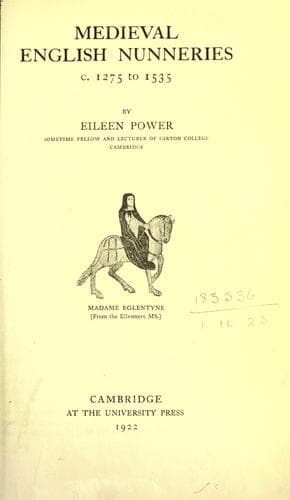
Medieval English Nunneries c. 1275 to 1535 — John Shaqi
Medieval English Nunneries c. 1275 to 1535Power, Eileen
History
Medieval English Nunneries c. 1275 to 1535
Power, Eileen
Convents -- England; Monastic and religious life of women -- History
said the Prioress, "some of thies yong Nunnes be to blame," and on the
director asking why, she replied: "For they wolde not shewe me so muche;
for I asked diverse of them before this day to whome they wolde gyve their
voices, but they wolde not shewe me." "What said they to you?" asked the
director. "They said to me," replied the flustered and indignant prioress,
"they wolde not tell to whome they wolde gyve their voices tyll the tyme
of thellection, and then they wolde gyve their voices as God shulde put
into their mynds, but this is by counsaill. And yet yt wolde have beseemed
them to have shewn as much to me as to the others." And then she and Dame
Cecilia said, "What, shulde the yong nunnes gyve voices? Tushe, they
shulde not gyve voices!" Clearly the situation was the same which Jocelin
of Brakelond had described over three centuries before: "The novices said
of their elders that they were invalid old men and little capable of
ruling an abbey." However the Prioress was obliged to admit that the
younger nuns had voted in the last election and the subprioress thereupon,
in the name of the scrutineers, announced the election of Dame Elizabeth
Boifeld by the "more and sounder part of the convent" (poor Anne Wake!).
But the Prioress and disappointed Dame Cecilia still showed fight; the
votes must be referred to the Bishop of Lincoln. Further discussion; then
Dame Cecilia gracefully gave way; she consented to the election of Dame
Elizabeth Boifeld and would not proceed further in the matter. Master John
Rayn published the election at the steps of the altar. Helen Snawe (whom
after events showed to be a leading spirit in the affair) and Katherine
Wingate were chosen as proctors, to seek confirmation from the Bishop, and
Dame Elizabeth was taken to the altar (amid loud chanting of _Te Deum
Laudamus_ by the triumphant younger nuns) and her election announced. She,
however, preserved that decorous semblance of unwillingness, or at least
of indifference, which custom demanded from a successful candidate, even
when she had been pulling strings for days, for when the proctors came to
her at two o'clock "in a certain upper chamber called Marteyns, in our
monastery" and asked her consent to her election, "she neither gave it nor
refused." Away went the proctors, without so much as a wink to each other;
let us leave our elect to meditate upon the will of God. At four p.m. they
came to her "in a certain large garden, called the Pond Yard, within our
monastery"; and at their repeated instances she gave her consent.
"Wherefore we, the above-named nuns, pray the Lord Bishop to ratify and
confirm our election of the said Elizabeth Boyfeld as our Abbess." Which
the Lord Bishop did[162].
Public-domain text, read in full here on John Shaqi.
Reviews
Reviews
No reviews yet
Be the first to share your thoughts on this work.
Join the Discussion
Join the discussion
Sign in to leave a comment or review.
Sign InorCreate an account