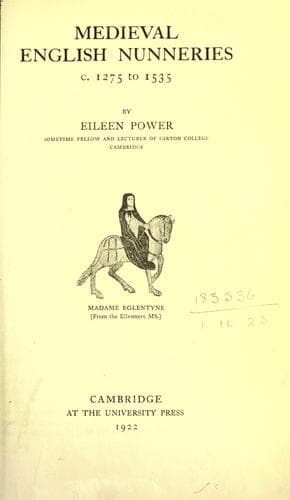
Medieval English Nunneries c. 1275 to 1535Power, Eileen
History
Medieval English Nunneries c. 1275 to 1535
Power, Eileen
Convents -- England; Monastic and religious life of women -- History
Such a survey as the _Valor Ecclesiasticus_, though valuable, could not by
its nature give more than the most general indication of the main classes
of receipts and expenditure of the nunneries. The accounts kept by the
nuns themselves, on the other hand, are a mine of detailed information on
these subjects. Every convent was supposed to draw up an annual balance
sheet, to be read before the nuns assembled in chapter, and though it was
a constant source of complaint against the head of a house that she failed
to do so, nevertheless enough rolls have survived to make it clear that
the practice was common. Indeed it would have been impossible to run a
community for long without keeping accounts. The finest set of these rolls
which has survived from a medieval nunnery is that of St Michael's
Stamford, in Northamptonshire[265]. There are twenty-four rolls, beginning
with one for the year 32-3 Edward I, and ranging over the greater part of
the fourteenth and fifteenth centuries. A study of them enables the
material life of the convent for two centuries to be reconstructed and
gives a vivid picture of its difficulties, for though the nuns only once
ended the year without a deficit and a list of debts, yet the debts owed
by various creditors to them were often larger than those which they owed.
A very good series also exists for St Mary de Pre, near St Albans, kept by
the wardens 1341-57 and by the Prioress 1461-93[266]; and there is in the
Record Office a valuable little book of accounts kept by the treasuresses
of Gracedieu (Belton) during the years 1414-18, which has been made
familiar to many readers by the use made of it by Cardinal Gasquet in
_English Monastic Life_[267]. Very full and interesting accounts have
also survived from St Radegund's Cambridge (1449-51, 1481-2)[268], Catesby
(1414-45)[269] and Swaffham Bulbeck (1483-4)[270]. These are all
prioresses' or treasuresses' accounts of the total expenditure of the
different houses; but there are in existence also a few obedientiaries'
accounts, chambresses' accounts from St Michael's Stamford and Syon and
cellaresses' accounts from Syon[271]. An analysis of these accounts shows,
better than any other means of information, the various sources from which
a medieval nunnery drew its income, and the chief classes of expenditure
which it had to meet. It will therefore be illuminating to consider in
turn the credit and debit side of a monastic balance sheet.
Public-domain text, read in full here on John Shaqi.
Reviews
Reviews
No reviews yet
Be the first to share your thoughts on this work.
Elsewhere in the archive
Join the Discussion
Join the discussion
Sign in to leave a comment or review.
Sign InorCreate an account