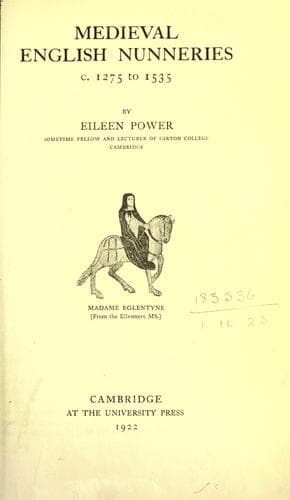
Medieval English Nunneries c. 1275 to 1535Power, Eileen
History
Medieval English Nunneries c. 1275 to 1535
Power, Eileen
Convents -- England; Monastic and religious life of women -- History
It is perhaps unnecessary to postulate that since monastic houses differed
greatly in size and wealth, the sources of their income would differ
accordingly. A very poor house might be dependent upon the rents and
produce of one small manor; a large house sometimes had estates all over
England. The entire income of Rothwell in Northamptonshire was derived
from one appropriated rectory, valued in the _Valor_ at L10. 10_s._ 4_d._
gross and at L5. 19_s._ 8_d._ net per annum[272]. The Black Ladies of
Brewood (Staffs.) had an income of L11. 1_s._ 6_d._ derived from demesne
in hand, rents and alms[273]. On the other hand Dartford in Kent held
lands in Kent, Surrey, Norfolk, Suffolk, Wiltshire, Wales and London[274],
the Minoresses without Aldgate held property in London, Hertfordshire,
Kent, Berkshire, Staffordshire, Derbyshire, Bedfordshire, Buckinghamshire,
Norfolk and the Isle of Wight[275]. The splendid Abbey of Syon held land
as far afield as Lancashire and Cornwall, scattered over twelve
counties[276]. Similarly the proportionate income derived from house-rents
and land-rents would differ with the geographical situation of the
nunnery. London convents, for instance, would draw a large income from
streets of houses, whereas a house in the distant dales of Yorkshire would
be dependent upon agriculture. At the time of the _Valor_ twenty-two
nunneries were holding urban tenements in fifteen towns, amounting in
total value to L1076. 0_s._ 7_d._, but of this sum L969. 11_s._ 10_d._ was
held by the seven houses in London[277]. With this proviso the conclusion
may be laid down that the money derived from the possession of
agricultural land, and in particular the rents paid by tenants in
freehold, copyhold, customary and leasehold land, was the mainstay of the
income paid into the hands of the treasuress.
A word may perhaps be said as to the method by which the nuns administered
their estates. Miss Jacka distinguishes two main types of administration,
discernible in the _Valor_:
Public-domain text, read in full here on John Shaqi.
Reviews
Reviews
No reviews yet
Be the first to share your thoughts on this work.
Elsewhere in the archive
Join the Discussion
Join the discussion
Sign in to leave a comment or review.
Sign InorCreate an account