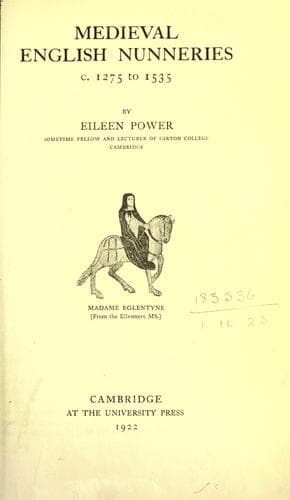
Medieval English Nunneries c. 1275 to 1535Power, Eileen
History
Medieval English Nunneries c. 1275 to 1535
Power, Eileen
Convents -- England; Monastic and religious life of women -- History
In most account rolls a careful distinction was drawn between "rents of
assize" and "farms." The former were the payments due from the tenants
(whether freehold or customary) who held their holdings at a money rent;
these rents were collected by the different collectors of the nunnery or
brought to the treasurers by the tenants themselves. "Farms" were leases,
i.e. payments for land or houses which were held directly in demesne by
the nunnery, but instead of being worked by a bailiff, or occupied by the
household, were "farmed out" at an annual rent. A "farmer" might thus hold
in farm an entire manor, and, for the payment of an annual sum to the
nuns, he would have the right to the produce of the demesne and to the
rents of rent-paying tenants. He might be quite a small person and hold in
farm only a few acres of the demesne (in addition perhaps to an ordinary
tenant's holding on the manor). He might hold the farm of a mill, or a
stable, or a single house[281]. In any case he paid a rent to the nuns and
made what he could out of his "farm"; while they much preferred these
regular payments to the trouble of superintending the cultivation of
distant lands, in an age when communication was difficult and slow.
Nevertheless the rents were not always easy to collect, for all the
diligence of the bailiff and of the various rent-collectors[282]. There
are some illuminating entries in the accounts of St Radegund's Cambridge.
In 1449-50 the indignant treasuress debits herself with "one tenement in
Walleslane lately held by John Walsheman for 6_s._ 8_d._ a year, the which
John fled out of this town within the first half of this year, leaving
nought behind him whereby he could be distrained save 7_d._, collected
therefrom"; and in the following year she again debits herself "for part
of a tenement lately held by John Webster for 12_s._ a year, whence was
collected only 7_s._ for that the aforesaid John Webster did flit
[literally, _devolavit_] by night, leaving naught behind him whereby he
could be distrained." Yet these nuns seem to have been indulgent
landlords; in this year the treasuress debits herself "for a tenement
lately held by Richard Pyghtesley, because it was too heavily charged
before, 2_s._ 3_d._, ... and for a portion of the rent owed by Stephen
Brasyer on account of the poverty and need of the said Stephen, by grace
of the lady Prioress this time only, 15_d._" and there are other instances
of lowered rents in these accounts[283]. Other account rolls sometimes
make mention of meals and small presents of money given to tenants
bringing in their rents.
Public-domain text, read in full here on John Shaqi.
Reviews
Reviews
No reviews yet
Be the first to share your thoughts on this work.
Elsewhere in the archive
Join the Discussion
Join the discussion
Sign in to leave a comment or review.
Sign InorCreate an account