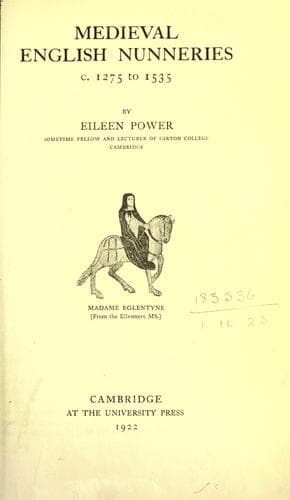
Medieval English Nunneries c. 1275 to 1535Power, Eileen
History
Medieval English Nunneries c. 1275 to 1535
Power, Eileen
Convents -- England; Monastic and religious life of women -- History
(2) _Various manorial perquisites and grants._ Besides the rents from land
and houses the position of a religious community as lord of a manor gave
it the right to various other financial payments. Of these the most
important were the perquisites of the manorial courts. These varied very
much according to the extent and number of the liberties which had been
granted to any particular house. To Syon, beloved of kings, vast liberties
had been granted (notably in 1447), so that the tenants upon its estates
were almost entirely exempt from royal justice. The abbess and convent had
view of frankpledge, leets, lawe-days and wapentakes for all people,
tenants resiant and other resiants aforesaid, in whatsoever places, by
the same abbess or her successors to be limited, where to them it
shall seem most expedient within the lordships, lands, rents, fees and
possessions aforesaid, to be holden by the steward or other officers.
They had the assizes of bread and ale and wine and victuals and weights
and measures. They had all the old traditional emoluments of justice,
which lords had striven to obtain since the days before the conquest,
soc, sac, infangentheof, outfangentheof, waif, estray, treasure-trove,
wreck of the sea, deodands, chattels of felons and fugitives, of
outlaws, of waive, of persons condemned, of felons of themselves
[suicides], escapes of felons, year day waste and estrepement and all
other commodities, forfeitures and profits whatsoever.
They had the right to erect gallows, pillory and tumbrel for the
punishment of malefactors. They even had
all issues and amercements, redemptions and forfeitures as well before
our [the king's] heirs and successors, as before the chancellor,
treasurer and barons of our exchequer, the justices and commissioners
of us, our heirs or successors whomsoever, made, forfeited or adjudged
... of all the people ... in the lordships, lands, tenements, fees and
possessions aforesaid[284].
In the eyes of the middle ages justice had one outstanding characteristic:
it filled the pocket of whoever administered it. "Justitia magnum
emolumentum est," as the phrase went. All the manifold perquisites of
justice, whether administered in her own or in the royal courts, went to
the abbess of Syon if any of her own tenants were concerned. It is no
wonder that out of a total income of L1944. 11_s._ 5-1/4_d._ the
substantial sum of L133. 0_s._ 6_d._ was derived from perquisites of
courts[285].
Public-domain text, read in full here on John Shaqi.
Reviews
Reviews
No reviews yet
Be the first to share your thoughts on this work.
Elsewhere in the archive
Join the Discussion
Join the discussion
Sign in to leave a comment or review.
Sign InorCreate an account