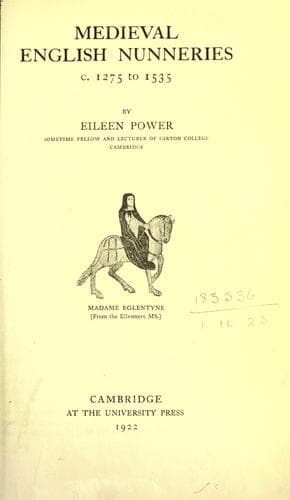
Medieval English Nunneries c. 1275 to 1535Power, Eileen
History
Medieval English Nunneries c. 1275 to 1535
Power, Eileen
Convents -- England; Monastic and religious life of women -- History
Few houses possessed such wholesale exemption from royal justice, but all
possessed their manorial courts, at which tenants paid their heriots in
money or in kind as a death-duty to the lord, or their fines on entering
upon land, and at which justice was done and offenders amerced (or fined
as we should now call it). Most houses possessed the right to hold the
assize of bread and ale and to fine alewives who overcharged or gave short
measure. Some possessed the right to seize the chattels of fugitives, and
the abbess of Wherwell was once involved in a law suit over this liberty,
which she held in the hundred of Mestowe and which was disputed by the
crown officials. One Henry Harold of Wherwell had killed his wife Isabel
and fled to the church of Wherwell and the Abbess had seized his chattels
to the value of L35. 4_s._ 8_d._ by the hands of her reeve[286]. A less
usual privilege was that of the Abbess of Marham, who possessed the right
of proving the wills of those who died within the precincts or
jurisdiction of the house[287]. The courts at which these liberties were
exercised were held by the steward of the nunnery, who went from manor to
manor to preside at their sittings; but sometimes the head of the house
herself would accompany him. Christian Bassett, the energetic Prioress of
Delapre (St Albans), not content with journeying up to London for a
lawsuit, went twice to preside at her court at Wing[288].
In rather a different class from grants of jurisdictional liberties were
special grants of free warren, felling of wood and fairs. Monasteries
which possessed lands within the bounds of a royal forest were not allowed
to take game or to cut down wood there without a special licence from the
crown; but such grants to exercise "free warren" (i.e. take game) and to
fell wood were often granted in perpetuity, as an act of piety by the
king, or for special purposes. The Abbess of Syon had free warren in all
her possessions, and in 1489 it was recorded that the Abbess of Barking
had free chase within the bailiwick of Hainault to hunt all beasts of the
forest in season, except deer, and free chase within the forest and
without to hunt hares and rabbits and fox, badger, cat and other
vermin[289]. Grants of wood were more often made on special occasions;
thus in 1277 the keeper of the forest of Essex was ordered to permit the
Abbess of Barking and her men to fell oak-trees and oak-trunks in her
demesne woods within the forest to the value of L40[290], while in 1299
the Abbess of Wilton was given leave to fell sixty oaks in her own wood
within the bounds of the forest of Savernake, in order to rebuild some of
her houses, which had been burnt down[291]. The grant of fairs and markets
was even more common and more lucrative, for the convent profited not only
from the rents of booths and from the entrance-tolls, but not infrequently
from setting up a stall of its own, for the sale of spices and other
produce[292].
Public-domain text, read in full here on John Shaqi.
Reviews
Reviews
No reviews yet
Be the first to share your thoughts on this work.
Elsewhere in the archive
Join the Discussion
Join the discussion
Sign in to leave a comment or review.
Sign InorCreate an account