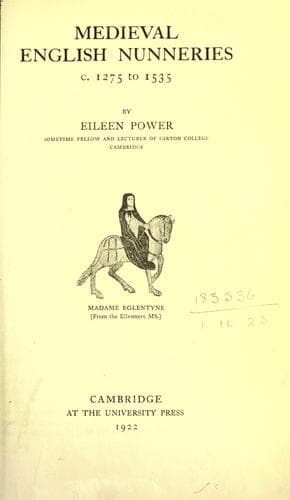
Medieval English Nunneries c. 1275 to 1535Power, Eileen
History
Medieval English Nunneries c. 1275 to 1535
Power, Eileen
Convents -- England; Monastic and religious life of women -- History
Henry III granted the nuns of Catesby a weekly market every
Monday within their manor of Catesby and a yearly fair for three days in
the same place; and almost any monastic chartulary will provide other
instances of such rights[293].
The majority of the special perquisites which have been described would
originate in special grants from the Crown; but it must be remembered that
every manorial lord could count on certain perquisites _ex officio_, for
which no specific grant was required. For his manor provided him with more
than agricultural produce on the one hand and rents and farms on the
other. Through the manor court he also received certain payments due to
him from all free and unfree tenants, in particular those connected with
the transfer of land, the heriot and the fines already mentioned. From
unfree tenants he could also claim various other dues, the mark of their
status; merchet, when their daughters married off the estate, leyrwite,
when they enjoyed themselves without the intermediary of that important
ceremony, a fine when they wished to send their sons to school and a
number of other customary payments, exacted at the manor court and varying
slightly from manor to manor. Moreover the tolls from the water- or
wind-mill at which villeins had to grind their corn all went to swell the
purse of the lord[294]. This is not the place for a detailed description
of manorial rights, which can be studied in any text-book of economic
history[295]; a word must, however, be said about the mortuary system,
which did not a little to enrich the medieval church.
When a peasant died the lord of the manor had often the right to claim his
best animal or garment as a mortuary or heriot, and by degrees there grew
up a similar claim to his second best possession on the part of the parish
priest.
"It was presumed," says Mr Coulton, "that the dead man must have
failed to some extent in due payment of tithes during his lifetime and
that a gift of his second best possession to the Church would
therefore be most salutary to his soul"[296].
Public-domain text, read in full here on John Shaqi.
Reviews
Reviews
No reviews yet
Be the first to share your thoughts on this work.
Elsewhere in the archive
Join the Discussion
Join the discussion
Sign in to leave a comment or review.
Sign InorCreate an account