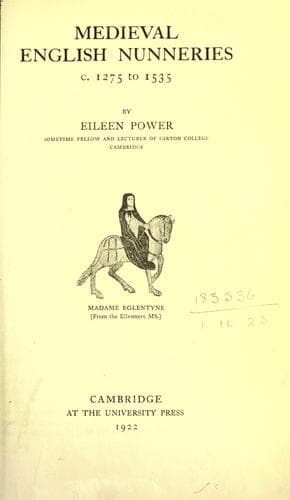
Medieval English Nunneries c. 1275 to 1535Power, Eileen
History
Medieval English Nunneries c. 1275 to 1535
Power, Eileen
Convents -- England; Monastic and religious life of women -- History
From these claims, partly manorial and partly ecclesiastical, religious
houses benefited very greatly, and their accounts sometimes mention
mortuary payments. The Prioress of Catesby in the year 1414-15 records how
her live stock was enriched by one horse, one mare and two cows coming as
heriots, while she received a payment of 20_s._ for two oxen coming as
heriot of Richard Sheperd[297]. In the chartulary of Marham is recorded a
mortuary list of sixteen people, who died within the jurisdiction of the
house, and the mortuaries vary from a sorrel horse and a book to numerous
gowns and mantles[298]. The system was obviously capable of great abuse,
and Mr Coulton considers that it did much to precipitate the Reformation,
for the unhappy peasant resented more and more bitterly the greed of the
church, which chose his hour of sorrow to wrest from him the best of his
poor possessions; it must have seemed hard to him that his horse or his ox
should be driven away, if he could not buy it back, to the well-stocked
farm of a community which was vowed to poverty, far harder than if his
lord were a layman, as free as he was himself to accumulate possessions
without soiling the soul. When the parish priest followed the convent with
a claim upon what was best, his despair must have grown deeper and his
resentment more bitter. It was often difficult to collect these payments,
just as it was often difficult to collect tithes, even when a priest was
less loth to curse for them than Chaucer's poor parson. Vicars were
obliged to sue their wretched parishioners in the ecclesiastical courts,
and monasteries were sometimes fain to commute such payments for an annual
rent, collected by the tenants[299]. But the best ecclesiastics recognised
that the system was somewhat out of keeping with Christian charity.
Caesarius of Heisterbach has a story of Ulrich, the good head of the
monastery of Steinfeld, who one day
came to one of his granges, wherein, seeing a comely foal, he enquired
of the [lay] brother whose it was or whence it came. To whom the
brother answered, "such and such a man, our good and faithful friend,
left it to us at his death." "By pure devotion," asked the provost,
"or by legal compulsion?" "It came through his death," answered the
other, "for his wife, since he was one of our serfs, offered it as a
heriot." Then the provost shook his head and piously answered:
"Because he was a good man and our faithful friend, therefore hast
thou despoiled his wife. Render therefore her horse to this forlorn
woman; for it is robbery to seize or detain other men's goods, since
the horse was not thine before [the man's death]"[300].
Public-domain text, read in full here on John Shaqi.
Reviews
Reviews
No reviews yet
Be the first to share your thoughts on this work.
Elsewhere in the archive
Join the Discussion
Join the discussion
Sign in to leave a comment or review.
Sign InorCreate an account