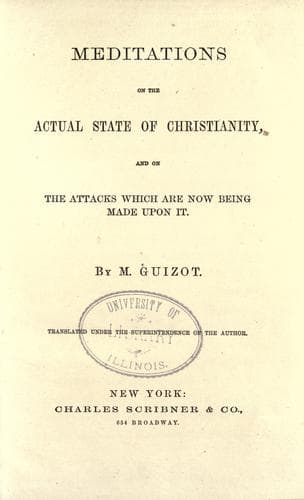
Meditations on the Actual State of Christianity, and on the Attacks Which Are Now Being Made Upon It.Guizot, François
Religion
Meditations on the Actual State of Christianity, and on the Attacks Which Are Now Being Made Upon It.
Guizot, François
Christianity; Philosophy and religion; Religious thought -- 19th century
themselves to be in possession of a key to open its secrets.
{321}
They see not that their key is a deception, that at each step
facts evident, indestructible, give the flattest denial to their
inferences, and that to maintain their arbitrary and insufficient
principle they are forced to ignore and to deny other facts,
themselves evident, indestructible.
Psychological observation proves and irresistibly establishes
three facts, however the consequences of these facts themselves
may lead to questions and controversies.
1. Man believes in his own existence, and in his own personality.
He feels himself and perceives himself to be a being, real and
distinct from every other being.
2. Man feels himself and knows himself to be a free agent. Of the
freedom of his resolves, whatever the motives and deliberations
which precede them, man has an intimate and assured
consciousness.
3. Good and evil exist in man, and exist in the world; moral good
and evil as well as physical good and evil. Whatever may be
thought of their origin, the mixture and the struggle of good and
of evil, in the moral order and in the physical order, are facts
evident in themselves, and attested by the conscience and by the
experience of the human race.
{322}
Pantheism sometimes ignores and omits, sometimes formally denies,
these facts, which psychology attests and proves. There is,
however, a notable difference in this point in the three great
representatives of Pantheism. Thanks to the Platonic school, from
which he sprang, Plotinus, in treating the different questions of
man's liberty and of the reality of good and of evil, soars in an
elevated region where the truth now shines in splendor, now
obscures itself and disappears in the labyrinth in which the
philosopher himself is entangled as soon as he attempts to
explain the one and infinite Being and that Being's relations
with nature and with man. Spinoza is more consequent and plainer.
He formally denies all individuality, all human liberty.
Substance, "_the being_" is single and universal.
{323}
All act of man, as every fact of nature, is produced by fated
laws and causes: "Free will is a chimera, flattering to our pride
and in reality founded upon our ignorance. All that I can say to
those who believe that they can, by virtue of any free decision
of the soul, speak or be silent--or, to use a single word,
act--is that they dream with their eyes open." [Footnote 66]
[Footnote 66: Œuvres de Spinoza, French translation of M. E.
Saisset, vol. i, Introduction, p. clii.]
Public-domain text, read in full here on John Shaqi.
Reviews
Reviews
No reviews yet
Be the first to share your thoughts on this work.
Elsewhere in the archive
Join the Discussion
Join the discussion
Sign in to leave a comment or review.
Sign InorCreate an account