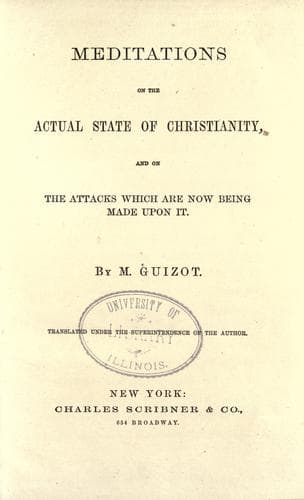
Meditations on the Actual State of Christianity, and on the Attacks Which Are Now Being Made Upon It.Guizot, François
Religion
Meditations on the Actual State of Christianity, and on the Attacks Which Are Now Being Made Upon It.
Guizot, François
Christianity; Philosophy and religion; Religious thought -- 19th century
"Intellectual life is an uninterrupted succession, not merely
of ideas, but of beliefs, explicit or implicit. The beliefs of
the mind are the force of the soul and the moving incentives of
the will. Whatever determines us to believe we call _evidence_.
... Reason renders no account of what is evident; to condemn it
to do so is to annihilate it, for it also has need of an
evidence peculiar to itself.
{361}
Did not reasoning rest upon principles anterior to the reason,
analysis would be without end, and synthesis without
commencement. The fundamental laws of belief constitute the
intelligence itself; and as those laws all flow from the same
source, they have the same authority; they judge by the same
right; there is no appeal from the tribunal of one to that of
another. Whoever revolts against any single one of these laws,
revolts against them all, and so abdicates all his nature. Are
there weapons of legitimate use against that faculty by which
we perceive the external world? These same weapons may be
turned against the conscience, the memory, the moral sense,
against reason itself. ... Let but, in any single point, the
nature of knowledge--the nature, I say, and not the degree--be
made subordinate to our means of knowing, and all certitude is
at an end; nothing is true, nothing is false. But it is not
enough to say this; for all is true and false altogether, since
truth and falsehood no longer differ from sweet and bitter.
{362}
The void itself is then deprived of its absolute nullity: it
enters into the domain of the relative; it is something,
nothing, according to the conformation of the spectator's eye.
The useful is the sole subject that the understanding
contemplates, the sole subject for which the heart has to make
its laws. A legislation capricious and without efficacy, which
applies only shifting rules to actions, and which has none for
the intentions and for the desires. This is not mere
declamation; all these consequences have been deduced from
skeptical doctrines with an exactitude leaving nothing to be
either desired or contested. It is then a fact that public and
private morality, the order of society and the happiness of
individuals, are directly at stake in the controversy between
true philosophy and false philosophy respecting the reality of
knowledge. For when existences themselves become problems, what
force remains to the bond that unites them? We cannot divide
the entire man; we cannot assign a part only to skepticism; as
soon as skepticism once penetrates into the understanding it
invades it throughout." [Footnote 78]
[Footnote 78: Fragments de M. Royer-Collard, in the works of
Reid, translation of M. Jouffroy, vol. iv, pp. 426-451.]
{363}
Public-domain text, read in full here on John Shaqi.
Reviews
Reviews
No reviews yet
Be the first to share your thoughts on this work.
Elsewhere in the archive
Join the Discussion
Join the discussion
Sign in to leave a comment or review.
Sign InorCreate an account