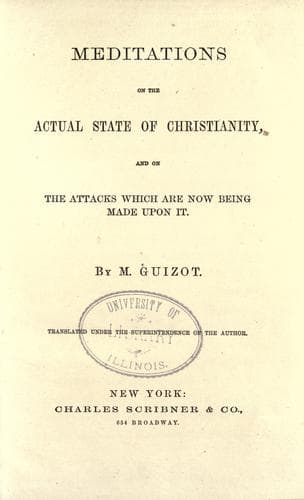
Meditations on the Actual State of Christianity, and on the Attacks Which Are Now Being Made Upon It. — John Shaqi
Meditations on the Actual State of Christianity, and on the Attacks Which Are Now Being Made Upon It.Guizot, François
Religion
Meditations on the Actual State of Christianity, and on the Attacks Which Are Now Being Made Upon It.
Guizot, François
Christianity; Philosophy and religion; Religious thought -- 19th century
In these days, and in some parts of Christendom, the Concordat
and the "Génie du Christianisme," the one as a political
institution, the other as a literary production, have lost
something of their vogue. Catholics, zealous and sincere,
criticise severely the defects of the Concordat; they regard it
as sometimes incomplete, sometimes tyrannical: they reproach it
with assailing the rights of religious society, of paralyzing its
influence, and restricting its liberty. Some go so far as to
express wishes for the separation of Church and State, and for
their entire independence of each other, the only certain
guarantee to either, they affirm, of a real moral influence.
Protestants, equally zealous and sincere, entertain the same
opinions and the same wishes. Not contented with this, the latter
have gone further, and acted; they have separated themselves from
the Protestant Church recognized by the State, and have founded
independent Churches, self-governing and self-sufficing; nor have
they demanded anything from the State but the liberty that is
every citizen's due.
{16}
In a work recently published, [Footnote 2] a pastor of one of
these Churches, a man distinguished both by the elevation of his
mind and the generosity of his sentiments, M. Edmond de
Pressensé, has gone still farther.
[Footnote 2: L'Église et la Revolution française,
histoire des relations de l'Église et de l'État,
de 1789-1802. 8vo. 1864.]
Not content with defending the principle of the separation of
Church and State, he has endeavored to prove that, in 1802, the
Concordat was, on the part of Napoleon, simply an act of tyranny
and ambition; that it was, as far as Christianity is concerned,
an untoward incident; and that if the Christian Church, at the
time spontaneously regenerating itself, had been left free and
uncontrolled, it would have risen by its own proper strength, and
would have grown in influence and in faith far more than the
Concordat has permitted it to do. I am far from proposing to
discuss here, as a general proposition, the system of separation
of Church and State, or its worth in a religious or social point
of view;
{17}
such a system I do not regard as the ideal of religious society:
the co-existence, I would rather say the competition, of Churches
recognized by the State and of Dissenting Churches independently
constituting themselves and self-sufficing, is, in my opinion,
the system most in conformity with the nature of things, and most
favorable to the solidity and general efficiency of religion.
That is a question rather of epoch, time, manners, and social
condition than of principle. But, however this may be, I hold it
as certain that, in 1802, the Concordat was, on the part of
Napoleon, far more an act of superior sagacity than of arbitrary
power, and that it was for the Christian religion in France an
event as salutary as necessary. After the anarchy and the orgies
of the Revolution, nothing but the solemn recognition of
Public-domain text, read in full here on John Shaqi.
Reviews
Reviews
No reviews yet
Be the first to share your thoughts on this work.
Join the Discussion
Join the discussion
Sign in to leave a comment or review.
Sign InorCreate an account