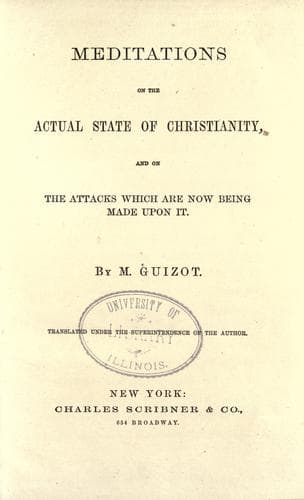
Meditations on the Actual State of Christianity, and on the Attacks Which Are Now Being Made Upon It.Guizot, François
Religion
Meditations on the Actual State of Christianity, and on the Attacks Which Are Now Being Made Upon It.
Guizot, François
Christianity; Philosophy and religion; Religious thought -- 19th century
Christianity by the State could have given satisfaction to the
public sentiment, and insured to the religion of Christ the
dignity and the stability, the recovery of which was so essential
to its influence.
{18}
Nothing is more liable to error than an attempt to appreciate,
with reference to present circumstances and the actual condition
of men's minds, what was possible and good sixty years ago; and I
am convinced, that in spite of his zeal for the separation of
Church and State, M. Edmond de Pressensé, had he lived in 1802,
would have been as little satisfied as France herself with a
Christian Church restored in accordance with the plan of the Abbe
Grégoire, The Concordat was a mixed and imperfect measure,
subject to grave objections, and the source of numberless
difficulties; but, taken altogether, the measure was grand and
salutary; it gave at once to the Christian movement a sanction
and an impulse that no other scheme would have been capable of
imparting.
M. de Chateaubriand and the "Génie du Christianisme" are entitled
to the same justice. I am ready, with regard to both book and
author, to concede the truth of all the objections and of all the
defects that the severest critic may be able or may wish to
detect; their grand and salutary action will not be the less a
living fact.
{19}
It is with books as it is with men; it is by their qualities,
whatever their faults, that they command position and exercise
sway, and wherever superior qualities are discernible, their
efficacy remains in spite of any faults, in spite of any defects,
by which they may be accompanied. Notwithstanding its
imperfections in a religious and literary point of view, the
"Génie du Christianisme" was in both these respects a performance
at the same time remarkable and powerful: it strongly moved men's
minds, it gave a fresh impulse to men's imaginations, it
reanimated and placed in their proper rank the traditions and the
early impressions of Christianity. No criticism, however
legitimate, can ever deprive that work of the place that it at
once assumed in the religious and the literary history of its
time and country.
{20}
Neither the Concordat nor the "Génie du Christianisme" was, in
1802, the result of a spirit of blind and barren reaction.
Napoleon and Chateaubriand were both, of them hardy innovators.
At the side of the ancient religion which he re-established,
Napoleon firmly maintained also the liberty of conscience,
whether in matters of worship or philosophy. At the very instant
when the Concordat was proclaimed and the "Génie du
Christianisme" was published, the learned physiologist, Cabanis,
also published his treatise on the relations of man's physical
and moral nature, a work which characterized man as a mere
machine. And in recalling France to an admiration of the beauties
of Christian literature, Chateaubriand imaged them to her in
forms of language so novel and so original, that many among the
severe guardians of the French language treated him as an
Public-domain text, read in full here on John Shaqi.
Reviews
Reviews
No reviews yet
Be the first to share your thoughts on this work.
Join the Discussion
Join the discussion
Sign in to leave a comment or review.
Sign InorCreate an account