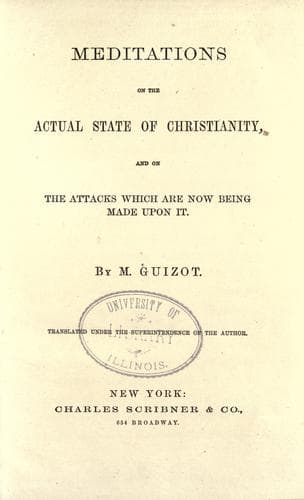
Meditations on the Actual State of Christianity, and on the Attacks Which Are Now Being Made Upon It.Guizot, François
Religion
Meditations on the Actual State of Christianity, and on the Attacks Which Are Now Being Made Upon It.
Guizot, François
Christianity; Philosophy and religion; Religious thought -- 19th century
pre-eminently the intellectual substance, the basis of man and of
philosophy; and the human being himself, in his personal unity,
with all his life and his free will, entirely disappeared from
their teaching.
As results of this system I will cite only two facts, very
different in their nature, both very foreign to the founder of
the system and his disciples, but which serve the better to
reveal that system's faultiness, as these facts are, although its
indirect, remote, and involuntary, nevertheless, its undeniable
consequences.
When, in 1793, the frenzied men who disposed, as masters, of the
destinies of France, abolished the Christian religion and
Christian worship, they resolved, nevertheless, to give to men an
object to adore. They instituted the worship of reason.
{250}
The church of Notre-Dame at Paris was metamorphosed into a temple
of reason; a young woman was made to figure there as the goddess
of reason; and the orator of the National Convention, Chaumette,
cried aloud as he pointed her out to the people, "Behold living
Reason; we celebrate here to-day the sole true worship, the
worship of Liberty and of Reason."
At the distance of three quarters of a century from the date of
these revolutionary orgies, in 1865, not in France but in
England, a man of earnest intentions, superior mind, and
extensive learning, whose sincerity is evident, and his
sentiments moral at once and moderate, writes a book entitled,
"Rationalism in Europe;" and the object of this book is to
establish, that all the good effected in Europe since the fall of
the Roman empire, all the progress made by states in justice, in
humanity, in liberty, and general happiness--whether in the
sphere of science or of practical industry--is due to the
influence of Rationalism, to its developments and its conquests.
{251}
Mr. Lecky is not a metaphysician; he attaches no precise and
philosophical meaning to the word "Rationalism;" he does not
trouble himself about the system of Kant, nor the place occupied
in it by the pure, the practical, or the aesthetic reason; he
only retraces the intellectual and social history of Europe, and
all the happy results that this history commemorates, all the
salutary consequences of the activity of the human mind, of the
liberty of man's thought, of the amelioration of human
institutions and manners, he sums up all in a single name,
attributes them to a single cause, and assigns all the honor to
the progress of Rationalism!
{252}
Arrived, nevertheless, at the conclusion of his work, a single
reflection disquiets Mr. Lecky: he asks himself whether, in
extolling the happy effects of what he styles Rationalism, he has
not gone too far, said too much, and hoped too much:
Public-domain text, read in full here on John Shaqi.
Reviews
Reviews
No reviews yet
Be the first to share your thoughts on this work.
Elsewhere in the archive
Join the Discussion
Join the discussion
Sign in to leave a comment or review.
Sign InorCreate an account