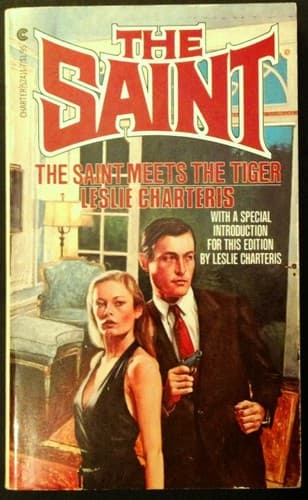
Detective and mystery stories; Private investigators -- England -- Fiction; Saint (Fictitious character) -- Fiction
“But of course,” assented the Saint, smiling, and she was left with a
sneaking suspicion that he was agreeing with her second sentence as
much as with her first.
Miss Girton arrived in a few moments, and Simon knew at once that
Baycombe had not exaggerated her grimness. “A norrer,” Orace had
reported, and the Saint felt inclined to agree. Miss Girton was stocky
and as broad as a man: he was surprised at the strength of her grip
when she shook hands with him. Her face was weather-beaten. She wore a
shirt and tie and a coarse tweed skirt, woollen stockings, and heavy
flat-heeled shoes. Her hair was cropped.
“I was wondering when I should meet you,” she said immediately. “You
must come to dinner and meet some people. I’m afraid the company’s
very limited here.”
“I’m afraid I’m prepared for very little company,” said Templar. “I’d
decided to forget dress clothes for a while.”
“Lunch, then. Would you like to stay to-day?”
“May I be excused? Don’t think me uncivil, but I promised my man I’d
be back for lunch. If I don’t turn up,” explained the Saint
ingenuously, “Orace would think something had happened to me, and he’d
go cruising round with his revolver, and somebody might get hurt.”
There was an awkward hiatus in the conversation at that point, but it
was confined to two of the party, for Templar was admiring a fine
specimen of Venetian glass, and did not seem to realise than he had
said anything unusual. The girl hastened into the breach.
“Mr. Templar has come here for adventure,” she said, and Miss Girton
stared.
“Well, I wish him luck,” she said shortly. “On Friday, then, Mr.
Templar? I’ll ask some people. . . .”
“Delighted,” murmured the Saint, bowing, and now there was something
faintly mocking about his smile. “On the whole, I don’t see why the
social amenities shouldn’t be observed, even in a vendetta.”
Miss Girton excused herself soon after, and the Saint smoked a
cigarette and chatted lightly and easily with Patricia Holm. He was an
entertaining talker, and he did not introduce any more dark and
horrific allusions into his remarks. Nevertheless, he caught the girl
looking at him from time to time with a kind of mixture of perplexity,
apprehension, and interest, and was hugely delighted.
At last he rose to go, and she accompanied him to the gate.
“You seem quite sane,” she said bluntly as they went down the path:
“What was the idea of talking all that rot?”
He looked down at her, his eyes dancing.
“All my life,” he replied, “I have told the truth. It is a great
advantage, because if you do that nobody ever takes you seriously.”
“But talking about murders and revolvers——”
Public-domain text, read in full here on John Shaqi.
Reviews
Reviews
No reviews yet
Be the first to share your thoughts on this work.
Join the Discussion
Join the discussion
Sign in to leave a comment or review.
Sign InorCreate an account