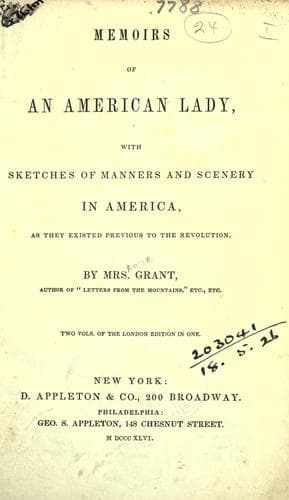
Memoirs of an American Lady: With Sketches of Manners and Scenery in America, as They Existed Previous to the RevolutionGrant, Anne MacVicar
History
Memoirs of an American Lady: With Sketches of Manners and Scenery in America, as They Existed Previous to the Revolution
Grant, Anne MacVicar
Indians of North America; New York (State) -- Social life and customs -- To 1775; Schuyler, Catalina, 1701-1778 or 1779
NOW the very ultimatum of degeneracy, in the opinion of these simple
good people, was approaching; for now the officers, encouraged by the
success of all their projects for amusement, resolved to new fashion and
enlighten those amiable novices whom their former schemes had attracted
within the sphere of their influence; and, for this purpose, a private
theatre was fitted up, and preparations made for acting a play. Except
the Schuylers and their adopted family, there was not, perhaps, one of
the natives who understood what was meant by a play. And by this time,
the town, once so closely united by intermarriages and numberless other
ties, which could not exist in any other state of society, were divided
into two factions; one consisting almost entirely of such of the younger
class, as, having a smattering of New-York education, and a little more
of dress and vivacity, or, perhaps, levity, than the rest, were eager to
mingle in the society, and adopt the manners of those strangers. It is
but just, however, to add, that only a few of the more estimable were
included in this number; these, however they might have been captivated
with novelty and plausibility, were too much attached to their older
relations to give them pain, by an intimacy with people to whom an
impious neglect of duties the most sacred, was generally imputed, and
whose manner of treating their inferiors, at that distance from the
control of higher powers, was often such as to justify the imputation of
cruelty, which the severity of military punishments had given rise to.
The play, however, was acted in a barn, and pretty well attended,
notwithstanding the good Domine’s earnest charges to the contrary. It
was the Beaux Stratagem; no favourable specimen of the delicacy or
morality of the British theatre; and as for the wit it contains, very
little of that was level to the comprehension of the novices who were
there first initiated into a knowledge of the magic of the scene, yet
they “laughed consumedly,” as Scrub says, and actually did so, “because
they were talking of him.” They laughed at Scrub’s gestures and
appearance: and they laughed very heartily at seeing the gay young
ensigns, whom they had been used to dance with, flirting fans,
displaying great hoops, and with painted cheeks and coloured eyebrows,
sailing about in female habiliments. This was a jest palpable and level
to every understanding; and it was not only an excellent good one, but
lasted a long while; for every time they looked at them when restored to
their own habits, they laughed anew at the recollection of their late
masquerade. “It is much,” says Falstaff, “that a lie with a grave face,
and a jest with a sad brow, will do with a fellow who never had the ache
in his shoulders.” One need only look back to the first rude efforts at
comic humour which delighted our fathers, to know what gross and feeble
jests amuse the mind, as yet a stranger to refinement. The loud and
Public-domain text, read in full here on John Shaqi.
Reviews
Reviews
No reviews yet
Be the first to share your thoughts on this work.
Elsewhere in the archive
Join the Discussion
Join the discussion
Sign in to leave a comment or review.
Sign InorCreate an account