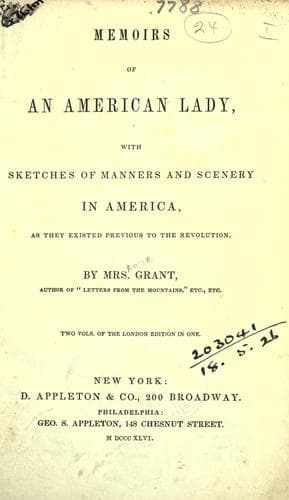
Memoirs of an American Lady: With Sketches of Manners and Scenery in America, as They Existed Previous to the Revolution — John Shaqi
Memoirs of an American Lady: With Sketches of Manners and Scenery in America, as They Existed Previous to the RevolutionGrant, Anne MacVicar
History
Memoirs of an American Lady: With Sketches of Manners and Scenery in America, as They Existed Previous to the Revolution
Grant, Anne MacVicar
Indians of North America; New York (State) -- Social life and customs -- To 1775; Schuyler, Catalina, 1701-1778 or 1779
Further on, much longer
carrying places frequently recurred—where they had the vessel and cargo
to drag through thickets, impervious to the day, abounding with snakes
and wild beasts, which are always to be found on the side of rivers.
Their provision of food was necessarily small, for fear of overloading
the slender and unstable conveyance already crowded with goods. A little
dried beef and Indian cornmeal was their whole stock, though they
formerly enjoyed both plenty and variety. They were, in a great measure,
obliged to depend upon their own skill in hunting and fishing, and the
hospitality of the Indians. For hunting, indeed, they had small leisure,
their time being sedulously employed, in consequence of the obstacles
that retarded their progress. In the slight and fragile canoes, they
often had to cross great lakes, on which the wind raised a terrible
surge. Afraid of going into the track of the French traders, who were
always dangerous rivals, and often declared enemies, they durst not
follow the direction of the river St. Lawrence; but, in search of
distant territories and unknown tribes, were wont to deviate to the east
and south-west, forcing their painful way towards the source of “rivers
unknown to song,” whose winding course was often interrupted by
shallows, and oftener still by fallen trees of great magnitude, lying
across, which it was requisite to cut through with their hatchets,
before they could proceed. Small rivers, which wind through fertile
valleys, in this country, are peculiarly liable to this obstruction. The
chestnut and hickory grew to so large a size in this kind of soil, that
in time they became top-heavy, and are then the first prey to the
violence of the winds; and thus falling, form a kind of accidental
bridge over these rivers.
Public-domain text, read in full here on John Shaqi.
Reviews
Reviews
No reviews yet
Be the first to share your thoughts on this work.
Join the Discussion
Join the discussion
Sign in to leave a comment or review.
Sign InorCreate an account