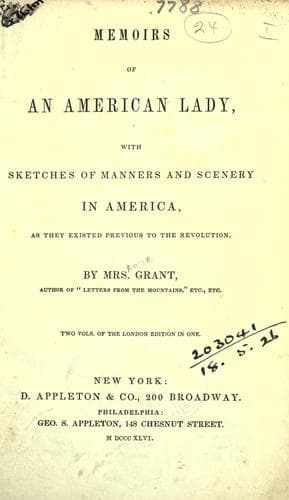
Memoirs of an American Lady: With Sketches of Manners and Scenery in America, as They Existed Previous to the RevolutionGrant, Anne MacVicar
History
Memoirs of an American Lady: With Sketches of Manners and Scenery in America, as They Existed Previous to the Revolution
Grant, Anne MacVicar
Indians of North America; New York (State) -- Social life and customs -- To 1775; Schuyler, Catalina, 1701-1778 or 1779
When the toils and dangers of the day were over, the still greater
terrors of the night commenced. In this, which might literally be styled
the howling wilderness, they were forced to sleep in the open air, which
was frequently loaded with the humid evaporation of swamps, ponds, and
redundant vegetation. Here the axe must be again employed to procure the
materials of a large fire, even in the warmest weather. This precaution
was necessary, that the flies and mosquitoes might be expelled by the
smoke, and that the wolves and bears might be deterred by the flame from
encroaching on their place of rest. But the light which afforded them
protection created fresh disturbance, as the American wolves howl to the
fires kindled to affright them—watching the whole night on the
surrounding hills to keep up a concert which truly “rendered night
hideous:” meantime the bull-frogs, terrible though harmless, and smaller
kinds, of various tones and countless numbers, seemed all night calling
to each other from opposite swamps, forming the most dismal assemblage
of discordant sounds. Though serpents abounded very much in the woods,
few of them were noxious. The rattle-snake, the only dangerous reptile,
was not so frequently met with as in the neighbouring provinces, and the
remedy which nature has bestowed as an antidote to his bite, was very
generally known. The beauties of rural and varied scenery seldom
compensated the traveller for the dangers of his journey. “In the close
prison of innumerous boughs,” and on ground thick with underwood, there
was little of landscape open to the eye. The banks of streams and lakes
no doubt afforded a rich variety of trees and plants—the former of a
most majestic size, the latter of singular beauty and luxuriance; but
otherwise they only travelled through a grove of chestnuts or oak, to
arrive at another of maple or poplar, or a vast stretch of pines and
other evergreens. If, by chance, they arrived at a hill crowned with
cedars, which afforded some command of prospect, still the gloomy and
interminable forest, only varied with different shades of green, met the
eye whichever way it turned, while the mind, repelled by solitude so
vast, and silence so profound, turned inward on itself. Nature here wore
a veil rich and grand, but impenetrable—at least this was the impression
it was likely to make on an European mind; but a native American,
familiar from childhood with the productions and inhabitants of the
woods, sought the nuts and wild fruits with which they abounded—the
nimble squirrel, in all its varied forms, the architect beaver, the
savage raccoon, and the stately elk, where we should see nothing but
awful solitudes, untrod by human foot. It is inconceivable how well
these young travellers, taught by their Indian friends, and the
experimental knowledge of their fathers, understood every soil and its
productions. A boy of twelve years old would astonish you with his
Public-domain text, read in full here on John Shaqi.
Reviews
Reviews
No reviews yet
Be the first to share your thoughts on this work.
Join the Discussion
Join the discussion
Sign in to leave a comment or review.
Sign InorCreate an account