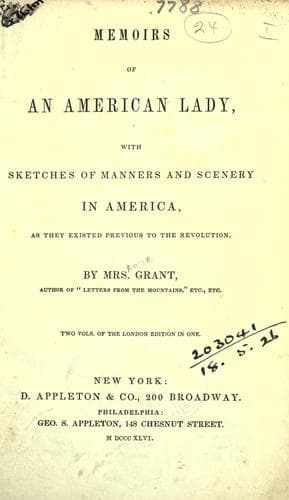
Memoirs of an American Lady: With Sketches of Manners and Scenery in America, as They Existed Previous to the RevolutionGrant, Anne MacVicar
History
Memoirs of an American Lady: With Sketches of Manners and Scenery in America, as They Existed Previous to the Revolution
Grant, Anne MacVicar
Indians of North America; New York (State) -- Social life and customs -- To 1775; Schuyler, Catalina, 1701-1778 or 1779
The joy that the return of these youths occasioned was proportioned to
the anxiety their perilous journey had produced. In some instances, the
union of the lovers immediately took place before the next career of
gainful hardships commenced. But the more cautious went to New-York in
winter, disposed of their peltry, purchased a larger cargo, and another
slave and canoe. The next year they laid out the profits of their former
adventures in flour and provisions, the staple of the province; this
they disposed of at the Bermuda Islands, where they generally purchased
one of those light-sailing cedar schooners, for building of which those
islanders are famous, and proceeding to the Leeward Islands, loaded it
with a cargo of rum, sugar, and molasses.
They were now ripened into men, and considered as active and useful
members of society, possessing a stake in the common weal.
The young adventurer had generally finished this process by the time he
was one, or, at most, two and twenty. He now married, or if married
before, which pretty often was the case, brought home his wife to a
house of his own. Either he kept his schooner, and, loading her with
produce, sailed up and down the river all summer, and all winter
disposed of the cargoes he obtained in exchange, to more distant
settlers; or he sold her, purchased European goods, and kept a store.
Otherwise he settled in the country, and became as diligent in his
agricultural pursuits as if he had never known any other.
-------
CHAP. X.
Marriages—Amusements—Rural excursions, &c. among the Albanians.
IT was in this manner that the young colonist made the transition from
boyhood to manhood; from the disengaged and careless bachelor, to the
provident and thoughtful father of a family; and thus was spent that
period of life, so critical in polished society, to those whose
condition exempts them from manual labour. Love, undiminished by any
rival passion, and cherished by innocence and candour, was here fixed by
the power of early habit, and strengthened by similarity of education,
tastes, and attachments. Inconstancy, or even indifference among married
couples, was unheard of, even where there happened to be a considerable
disparity in point of intellect. The extreme affection they bore their
mutual offspring, was a bond that forever endeared them to each other.
Marriage, in this colony, was always early, very often happy, and very
seldom, indeed, interested. When a man had no son, there was nothing to
be expected with a daughter but a well-brought-up female slave, and the
furniture of the best bed-chamber. At the death of her father, she
obtained another division of his effects, such as he thought she needed
or deserved, for there was no rule in these cases.
Public-domain text, read in full here on John Shaqi.
Reviews
Reviews
No reviews yet
Be the first to share your thoughts on this work.
Join the Discussion
Join the discussion
Sign in to leave a comment or review.
Sign InorCreate an account