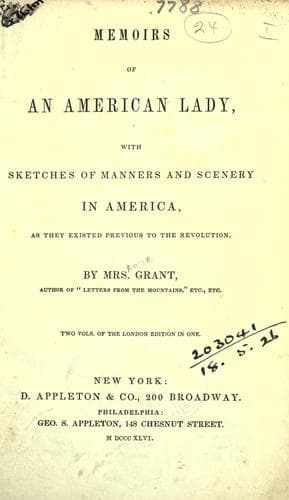
Memoirs of an American Lady: With Sketches of Manners and Scenery in America, as They Existed Previous to the RevolutionGrant, Anne MacVicar
History
Memoirs of an American Lady: With Sketches of Manners and Scenery in America, as They Existed Previous to the Revolution
Grant, Anne MacVicar
Indians of North America; New York (State) -- Social life and customs -- To 1775; Schuyler, Catalina, 1701-1778 or 1779
Such was the manner in which those colonists began life; nor must it be
thought that those were mean or uninformed persons. Patriots,
magistrates, generals, those who were afterwards wealthy, powerful, and
distinguished, all—except a few elder brothers, occupied by their
possessions at home—set out in the same manner; and, in after life, even
in the most prosperous circumstances, they delighted to recount the
“humble toils and destiny obscure,” of their early years.
The very idea of being ashamed of any thing that was neither vicious nor
indecent, never entered an Albanian head. Early accustomed to this noble
simplicity, this dignified candour, I cannot express the contempt and
disgust I felt at the shame of honourable poverty. The extreme desire of
concealing our real condition, and appearing what we are not, that
peculiarly characterizes, I had almost said disgraces, the northern part
more particularly of this island. I have often wondered how this vile
sentiment, that undermines all true greatness of mind, should prevail
more here than in England, where wealth, beyond a doubt, is more
respected, at least preponderates more over birth, and heart, and mind,
and many other valuable considerations. As a people, we certainly are
not sordid, why then should we descend to the meanness of being ashamed
of our condition, while we have not done any thing to degrade ourselves?
Why add a sting to poverty, and a plume to vanity, by the poor
transparent artifice that conceals nothing, and only changes pity into
scorn?
Before I quit the subject of Albanian manners, I must describe their
amusements, and some other peculiarities, in their modes of life. When I
say their amusements, I mean those in which they differed from most
other people. Such as they had in common with others, require no
description. They were exceedingly social, and visited each other very
frequently, beside the regular assembling together in their porches,
every fine evening. Of the more substantial luxuries of the table, they
knew little, and of the formal and ceremonious parts of good breeding,
still less.
Public-domain text, read in full here on John Shaqi.
Reviews
Reviews
No reviews yet
Be the first to share your thoughts on this work.
Join the Discussion
Join the discussion
Sign in to leave a comment or review.
Sign InorCreate an account