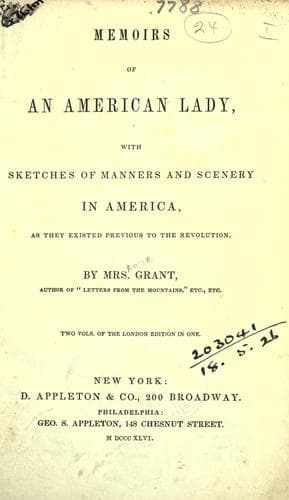
Memoirs of an American Lady: With Sketches of Manners and Scenery in America, as They Existed Previous to the RevolutionGrant, Anne MacVicar
History
Memoirs of an American Lady: With Sketches of Manners and Scenery in America, as They Existed Previous to the Revolution
Grant, Anne MacVicar
Indians of North America; New York (State) -- Social life and customs -- To 1775; Schuyler, Catalina, 1701-1778 or 1779
These were a few idle young men, the sons of avaricious fathers, who
grudging to advance the means of pushing them forward, by the help of
their own industry, to independence, allowed them to remain so long
unoccupied, that their time was wasted, and habits of conviviality at
length degenerated into those of dissipation. These were not only pitied
and endured, but received with a great deal of kindness and indulgence,
that was wonderful. They were usually a kind of wags, went about like
privileged persons, at whose jests no one took offence, and were in
their discourse and style of humour, so much like Shakspeare’s clowns,
that on reading that admirable author, I thought I recognized my old
acquaintances. Of these, however, I saw little, the society admitted at
my friends being very select.
-------
CHAP. XII.
Lay-Brothers—Catalina—Detached Indians.
Before I quit this attempt to delineate the number of which this
community was composed, I must mention a class of aged persons, who,
united by the same recollections, pursuits, and topics, associated very
much with each other, and very little with a world which they seemed to
have renounced. They might be styled lay-brothers, and were usually
widowers, or persons who, in consequence of some early disappointment,
had remained unmarried. These were not devotees, who had, as was
formerly often the case in Catholic countries, run from the extreme of
licentiousness to that of bigotry. They were generally persons who were
never marked as being irreligious or immoral—and just as little
distinguished for peculiar strictness or devotional fervour. These good
men lived in the house of some relation, where they had their own
apartments to themselves, and only occasionally mixed with the family.
The people of the town lived to a great age; ninety was frequently
attained, and I have seen different individuals of both sexes, who had
reached a hundred. These ancients seemed to place all their delight in
pious books and devotional exercises, particularly in singing psalms,
which they would do in their own apartments for hours together. They
came out and in like ghosts, and were treated in the same manner, for
they never spoke unless when addressed, and seemed very careless of the
things of this world, like people who had got above it. Yet they were
much together, and seemed to enjoy each other’s conversation.
Retrospection on the scenes of early life, anticipations of that
futurity, so closely veiled from our sight, and discussions regarding
different passages of holy writ, seemed their favourite themes. They
were mild and benevolent, but abstracted, and unlike other people, their
happiness, for happy I am convinced they were, was of a nature peculiar
to themselves, not obvious to others. Others there were not deficient in
their attention to religious duties, who, living in the bosom of their
Public-domain text, read in full here on John Shaqi.
Reviews
Reviews
No reviews yet
Be the first to share your thoughts on this work.
Join the Discussion
Join the discussion
Sign in to leave a comment or review.
Sign InorCreate an account