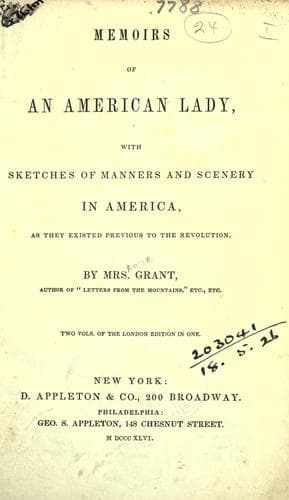
Memoirs of an American Lady: With Sketches of Manners and Scenery in America, as They Existed Previous to the RevolutionGrant, Anne MacVicar
History
Memoirs of an American Lady: With Sketches of Manners and Scenery in America, as They Existed Previous to the Revolution
Grant, Anne MacVicar
Indians of North America; New York (State) -- Social life and customs -- To 1775; Schuyler, Catalina, 1701-1778 or 1779
families, took an active and cheerful concern to the last, in all that
amused or interested them; and I never understood that the lay-brothers,
as I have chosen to call them, blamed them for so doing. One of the
first Christian virtues, charity, in the most obvious and common sense
of the word, had little scope. Here a beggar was unheard of. People,
such as I have described in the _bush_, or going there, were no more
considered as objects of pity, than we consider an apprentice as such,
for having to serve his time before he sets up for himself. In such
cases, the wealthier, because older settlers, frequently gave a heifer
or colt each, to a new beginner, who set about clearing land in their
vicinity. Orphans were never neglected; and from their early marriages,
and the casualties their manner of life subjected them to, these were
not unfrequent. You never entered a house without meeting children;
maidens, bachelors, and childless married people, all adopted orphans,
and all treated them as if they were their own.
Having given a sketch, that appears to my recollection, (aided by
subsequent conversations with my fellow-travellers,) a faithful one of
the country and its inhabitants, it is time to return to the history of
the mind of Miss Schuyler, for by no other circumstances than
prematurity of intellect, and superior culture, were her earliest years
distinguished. Her father, dying early, left her very much to the
tuition of his brother. Her uncle’s frontier situation, made him a kind
of barrier to the settlement; while the powerful influence that his
knowledge of nature and of character, his sound judgment and unstained
integrity, had obtained over both parties, made him the bond by which
the aborigines were united with the colonists. Thus, little leisure was
left him for domestic enjoyments or literary pursuits, for both of which
his mind was peculiarly adapted. Of the leisure time he could command,
however, he made the best use, and soon distinguished Catalina as the
one amongst his family to whom nature had been most liberal; he was at
the pains to cultivate her taste for reading, which soon discovered
itself, by procuring for her the best authors in history, divinity, and
belles lettres; in this latter branch, her reading was not very
extensive, but then the few books of this kind that she possessed, were
very well chosen, and she was early and intimately familiar with them.
What I remember of her, assisted by comparisons since made with others,
has led me to think that extensive reading, superficial and
indiscriminate—such as the very easy access to books among us
encourages, is not at an early period of life, favourable to solid
thinking, true taste, or fixed principle. Whatever she knew, she knew to
the bottom; and the reflections which were thus suggested to her strong,
discerning mind, were digested by means of easy and instructive
conversation. Colonel Schuyler had many relations in New-York—and the
Public-domain text, read in full here on John Shaqi.
Reviews
Reviews
No reviews yet
Be the first to share your thoughts on this work.
Join the Discussion
Join the discussion
Sign in to leave a comment or review.
Sign InorCreate an account