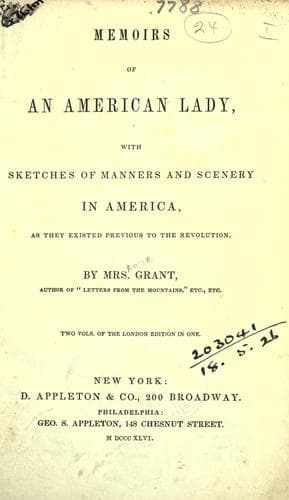
Memoirs of an American Lady: With Sketches of Manners and Scenery in America, as They Existed Previous to the RevolutionGrant, Anne MacVicar
History
Memoirs of an American Lady: With Sketches of Manners and Scenery in America, as They Existed Previous to the Revolution
Grant, Anne MacVicar
Indians of North America; New York (State) -- Social life and customs -- To 1775; Schuyler, Catalina, 1701-1778 or 1779
LIX. The Swamp—A discovery 312
LX. Mrs. Schuyler’s view of continental 318
politics
LXI. Description of the breaking up of the 321
ice on the Hudson river
LXII. Departure from Albany—Origin of the 325
state of Vermont
LXIII. General reflections 331
LXIV. Reflections continued 338
LXV. Sketch of the settlement of Pennsylvania 344
LXVI. Prospects brightening in British 351
America—Desirable country on the
interior lakes, &c.
------------------------------------------------------------------------
INTRODUCTION.
-------
To ——
DEAR SIR,
OTHERS as well as you have expressed a wish to see a memoir of my
earliest and most valued friend. To gratify you and them I feel many
inducements, and see many objections. To comply with any wish of yours
is one strong inducement. To please myself with the recollection of past
happiness and departed worth, is another; and to benefit those into
whose hands this imperfect sketch may fall, is a third. For the
authentic record of an exemplary life, though delivered in the most
unadorned manner, or even degraded by poverty of style or uncouthness of
narration, has an attraction for the uncorrupted mind.
It is the rare lot of some exalted characters, by the united power of
virtues and of talents, to soar above their fellow-mortals, and leave a
luminous track behind, on which successive ages gaze with wonder and
delight. But the sweet influence of these benign stars that now and then
enlighten the page of history, is partial and unfrequent.
Those to whom the most important parts on the stage of life are
allotted, if possessed of abilities undirected by virtue, are too often
“Wise to no purpose, artful to no end,”
that is really good and desirable.
They, again, where virtue is not supported by wisdom, are often, with
the best intentions, made subservient to the short-sighted craft of the
artful and designing. Hence, though we may be at times dazzled with the
blaze of heroic achievement, or contemplate with a purer satisfaction
those “awful fathers of mankind,” by whom nations were civilized,
equitable dominion established, or liberty restored; yet, after all, the
crimes and miseries of mankind form such prominent features of the
history of every country, that humanity sickens at the retrospect, and
misanthropy finds an excuse amidst the laurels of the hero, and the
deep-laid schemes of the politician:
“And yet this partial view of things
Is surely not the best.”—_Burns._
Public-domain text, read in full here on John Shaqi.
Reviews
Reviews
No reviews yet
Be the first to share your thoughts on this work.
Join the Discussion
Join the discussion
Sign in to leave a comment or review.
Sign InorCreate an account