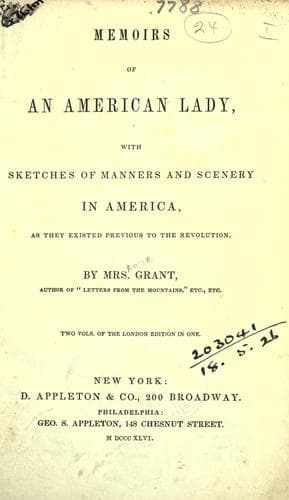
Memoirs of an American Lady: With Sketches of Manners and Scenery in America, as They Existed Previous to the RevolutionGrant, Anne MacVicar
History
Memoirs of an American Lady: With Sketches of Manners and Scenery in America, as They Existed Previous to the Revolution
Grant, Anne MacVicar
Indians of North America; New York (State) -- Social life and customs -- To 1775; Schuyler, Catalina, 1701-1778 or 1779
IT is well known that the province of New-York, anciently called
Manahattos by the Indians, was originally settled by a Dutch colony,
which came from Holland, I think, in the time of Charles the Second.
Finding the country to their liking, they were followed by others more
wealthy and better informed. Some of the early emigrants also appear to
have been people respectable both from their family and character. Of
these the principal were the Cuylers, the Schuylers, the Rensselaers,
the Delanceys, the Cortlandts, the Tenbroeks, and the Beekmans, who have
all of them been since distinguished in the late civil wars, either as
persecuted loyalists or triumphant patriots. I do not precisely
recollect the motives assigned for the voluntary exile of persons who
were evidently in circumstances that might admit of their living in
comfort at home, but am apt to think that the early settlers were those
who adhered to the interest of the Stadtholder’s family, a party which,
during the minority of King William, was almost persecuted by the high
republicans. Those who came over at a later period probably belong to
the party which opposed the Stadtholder, and which was then in its turn
depressed. These persons afterwards distinguished themselves by an
aversion, almost amounting to antipathy, to the British army, and indeed
to all the British colonists. Their notions were mean and contracted;
their manners blunt and austere; and their habits sordid and
parsimonious. As the settlement began to extend they retired, and formed
new establishments, afterwards called Fishkill, Esopus, &c.
To the Schuylers, Cuylers, Delanceys, Cortlandts, and a few others, this
description did by no means apply. They carried about them the tokens of
former affluence and respectability, such as family plate, portraits of
their ancestors executed in a superior style, and great numbers of
original paintings, some of which were much admired by acknowledged
judges. Of these the subjects were generally taken from sacred history.
I do not recollect the exact time, but think it was during the last
years of Charles the Second, that a settlement we then possessed at
Surinam was exchanged for the extensive (indeed at that time boundless)
province of Manahattos, which, in compliment to the then heir apparent,
was called New-York. Of the part of that country then explored, the most
fertile and beautiful was situated far inland, on the banks of the
Hudson River. This copious and majestic stream is navigable one hundred
and seventy miles from its mouth for vessels of sixty or seventy tons
burthen. Near the head of it, as a kind of barrier against the natives,
and a central resort for traders, the foundation was laid of a town
called Oranienburgh, and afterwards by the British, Albany.
Public-domain text, read in full here on John Shaqi.
Reviews
Reviews
No reviews yet
Be the first to share your thoughts on this work.
Join the Discussion
Join the discussion
Sign in to leave a comment or review.
Sign InorCreate an account