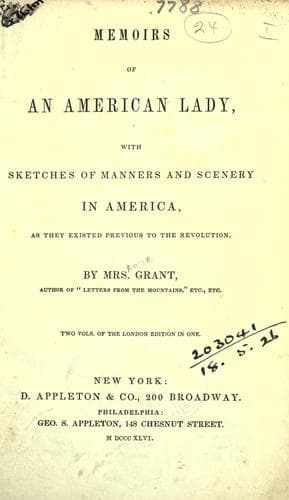
Memoirs of an American Lady: With Sketches of Manners and Scenery in America, as They Existed Previous to the RevolutionGrant, Anne MacVicar
History
Memoirs of an American Lady: With Sketches of Manners and Scenery in America, as They Existed Previous to the Revolution
Grant, Anne MacVicar
Indians of North America; New York (State) -- Social life and customs -- To 1775; Schuyler, Catalina, 1701-1778 or 1779
After the necessary precaution of erecting a small stockaded fort for
security, a church was built in the centre of the intended town, which
served in different respects as a kind of landmark. A gentleman of the
name of Rensselaer was considered as in a manner lord paramount of this
city. A pre-eminence which his successor still enjoys, both with regard
to the town and the lands adjacent. The original proprietor having
obtained from the high and mighty states a grant of lands, which,
beginning at the church, extended twelve miles in every direction,
forming a manor twenty-four Dutch miles in length, the same in breadth,
including lands not only of the best quality of any in the province, but
the most happily situated both for the purposes of commerce and
agriculture. This great proprietor was looked up to as much as
republicans in a new country could be supposed to look up to any one. He
was called the Patroon, a designation tantamount to lord of the manor.
Yet, in the distribution of these lands, the sturdy Belgian spirit of
independence set limits to the power and profits of this lord of the
forests, as he might then be called. None of these lands were either
sold or alienated. The more wealthy settlers, as the Schuylers, Cuylers,
&c. took very extensive leases of the fertile plains along the river,
with boundless liberty of woods and pasturage, to the westward. The
terms were, that the lease should hold while water runs and grass grows,
and the landlord to receive the tenth sheaf of every kind of grain the
ground produces. Thus ever accommodating the rent to the fertility of
the soil, and changes of the seasons, you may suppose the tenants did
not greatly fear a landlord, who could neither remove them, nor increase
their rents. Thus, without the pride of property, they had all the
independence of proprietors. They were like German princes, who, after
furnishing their contingent to the Emperor, might make war on him when
they chose. Besides the profits (yearly augmenting) which the patroon
drew from his ample possessions, he held in his own hands an extensive
and fruitful demesne. Yet preserving in a great measure the simple and
frugal habits of his ancestors, his wealth was not an object of envy,
nor a source of corruption to his fellow-citizens. To the northward of
these bounds, and at the southern extremity also, the Schuylers and
Cuylers held lands of their own. But the only other great landholders I
remember, holding their land by those original tenures, were Philips and
Cortlandt; their lands lay also on the Hudson River, half way down to
New-York, and were denominated Philips’ and Cortlandt’s manors. At the
time of the first settling of the country the Indians were numerous and
powerful all along the river; but they consisted of wandering families,
who, though they affixed some sort of local boundaries for
distinguishing the hunting grounds of each tribe, could not be said to
inhabit any place.
Public-domain text, read in full here on John Shaqi.
Reviews
Reviews
No reviews yet
Be the first to share your thoughts on this work.
Join the Discussion
Join the discussion
Sign in to leave a comment or review.
Sign InorCreate an account