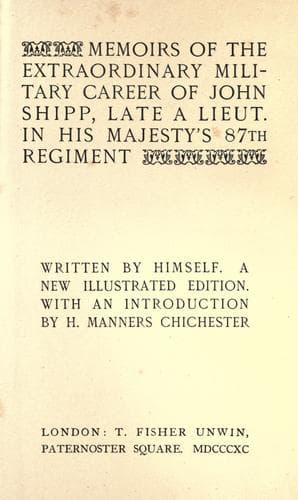
Memoirs of the Extraordinary Military Career of John Shipp: Late a Lieut. in His Majesty's 87th Regiment — John Shaqi
Memoirs of the Extraordinary Military Career of John Shipp: Late a Lieut. in His Majesty's 87th RegimentShipp, John
History
Memoirs of the Extraordinary Military Career of John Shipp: Late a Lieut. in His Majesty's 87th Regiment
Shipp, John
India -- History -- British occupation, 1765-1947 -- Biography; Shipp, John, 1784-1834
At the latter end of this year a series of unfortunate occurrences
began, which brought Shipp's military career to an untimely close. He
appears to have entered into a racing partnership with Lieut.-Colonel
Browne, of the same regiment, to run horses at Cawnpore races. Shipp,
who was supposed to be a good judge of horseflesh, was to make certain
purchases, for the purpose, at Calcutta. Colonel Browne, who died in
command of the regiment in Burmah a few years afterwards, was then one
of the regimental majors. He was a brave officer and, it is said, much
liked in the regiment; but it does not seem to have occurred to him or
any one else that to encourage a junior officer in Shipp's position--a
moneyless man, with family ties--to embark in turf speculations was a
most unfriendly action. The partners speedily fell out, each accusing
the other of "throwing him over." Browne claimed 2,000 rupees from
Shipp, which the latter admitted he had not the means to pay; and Shipp
then accused Browne of prejudicing the minds of the other officers
against him. This state of things continued until Shipp had a
misunderstanding with a civilian at Calcutta, in consequence of which
his brother officers treated him with marked coolness. Whether there
were sufficient grounds for so doing does not appear; but when Shipp
asked that his conduct in the matter might be investigated by
court-martial--the only course open to an officer without the means to
go to the civil courts--he was told that the Judge Advocate-General
considered it unnecessary. Worried by pecuniary difficulties, and
smarting under what he considered undeserved treatment by his former
associates, which he attributed to the hostile influence of Colonel
Browne, Shipp wrote some intemperate letters reflecting on the conduct
of Colonel Browne and of the regimental commanding officer. These he
stubbornly refused to withdraw; although in after years he admitted that
they were unjust and written under a misapprehension of facts. The
inevitable result followed. Shipp was brought before an European
General Court Martial on specific charges of unofficer-like conduct. The
court, of which Colonel Baldock, 29th Bengal Native Infantry, was
president, assembled at Fort William on July 14, 1823, and after
thirteen days' sitting found Shipp guilty of both the charges of
unofficer-like conduct preferred against him, and sentenced him to be
"discharged" from the service; but, at the same time, strongly
recommended him to mercy in consideration of his past services and
wounds, and the high character as an officer and a gentleman that he had
previously borne. The proceedings of the court were sent home for
confirmation, and eighteen months later were returned with the
notification that Shipp was to be permitted to retire from the service.
He accordingly returned home, and sold out of the regiment on November
3, 1825, about a month after his arrival in England. With their
Public-domain text, read in full here on John Shaqi.
Reviews
Reviews
No reviews yet
Be the first to share your thoughts on this work.
Join the Discussion
Join the discussion
Sign in to leave a comment or review.
Sign InorCreate an account