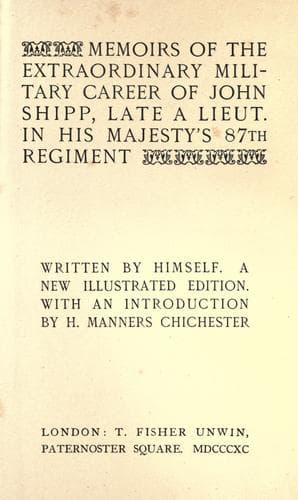
Memoirs of the Extraordinary Military Career of John Shipp: Late a Lieut. in His Majesty's 87th Regiment — John Shaqi
Memoirs of the Extraordinary Military Career of John Shipp: Late a Lieut. in His Majesty's 87th RegimentShipp, John
History
Memoirs of the Extraordinary Military Career of John Shipp: Late a Lieut. in His Majesty's 87th Regiment
Shipp, John
India -- History -- British occupation, 1765-1947 -- Biography; Shipp, John, 1784-1834
customary generosity, the Court of Directors of the late East India
Company settled upon him a life pension of L50 a year, in consideration
of his Indian services.
Disappointed again and again in his hopes of obtaining civil employment,
Shipp tried his hand at authorship, and wrote a work entitled the
"Military Bijou," and other things. In 1829 he published "Memoirs of the
Extraordinary Military Career of John Shipp." The book was brought out
by the late Mr. Hurst, of Great Marlborough Street, and proved a
literary success. As a military critic observed at the time, "that a
friendless farmer's boy, ignorant, by his own admission, of the simplest
rudiments of education, and following the engrossing profession of a
soldier from an age scarcely beyond the pale of childhood, should have
qualified himself to be at once the hero and the author of so remarkable
a work argues no ordinary qualities in the individual." A no less
creditable feature, we may be permitted to add, is the fine, soldierly
sense of duty, which led Shipp to bow to his fate (p. 317), and to
abstain from making his autobiography a vehicle for either
self-exculpation or recrimination in regard of the matters that proved
the ruin of his professional life. Two years after the publication of
his memoirs, Shipp wrote a pamphlet entitled, "Flogging and its
Substitutes--A Voice from the Ranks." It was in the form of a letter to
the late Sir Francis Burdett, Bart., M.P., who in return sent the author
a douceur of L60. Shipp's views did not find general acceptance in
military circles at the time; but the substitutes for corporal
punishment which he advocated, including a system of pecuniary fines for
various military offences, have all been since adopted in the army, and
are now in force. About the same time the late Sir Charles Rowan,
K.C.B., then Colonel Rowan, one of the Commissioners of the new
Metropolitan Police, offered Shipp an inspectorship in the Stepney
division, which was gladly accepted. Subsequently he received the
appointment of Superintendent of the Night Watch at Liverpool. There he
proved himself a most capable and efficient officer. So highly, indeed,
was he esteemed in the borough, that when he offered himself for the
mastership of the Liverpool Workhouse, early in the year 1833, he was
elected to the post by an overwhelming majority of votes. The
comfortable competency thus assured to him he did not live long to
enjoy. An attack of pleurisy, after a few days of acute suffering,
carried him off on February 27, 1834, at the age of fifty-two.
Public-domain text, read in full here on John Shaqi.
Reviews
Reviews
No reviews yet
Be the first to share your thoughts on this work.
Join the Discussion
Join the discussion
Sign in to leave a comment or review.
Sign InorCreate an account