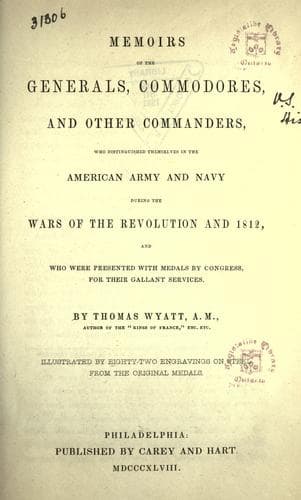
Memoirs of the Generals, Commodores and other Commanders, who distinguished themselves in the American army and navy during the wars of the Revolution and 1812, and who were presented with medals by Congress for their gallant servicesWyatt, Thomas
History
Memoirs of the Generals, Commodores and other Commanders, who distinguished themselves in the American army and navy during the wars of the Revolution and 1812, and who were presented with medals by Congress for their gallant services
Wyatt, Thomas
United States -- History -- Revolution, 1775-1783 -- Biography; United States -- History -- Revolution, 1775-1783 -- Medals; United States -- History -- War of 1812 -- Biography; United States -- History -- War of 1812 -- Medals
In part did he succeed, but the scarcity of provisions becoming so
great, that Washington was at length compelled to detach a body of
troops, under General Greene, with orders to obtain “an immediate
supply of provisions by any means within his power.” This was done by
seizing every animal fit for slaughter; and by this means the immediate
wants of the starving troops were supplied.
In order to prevent a similar deplorable state of want, our gallant
hero, who knew no danger, in the month of February, a most inclement
season, left the army with a body of troops on an expedition to New
Jersey, to secure cattle on the banks of the Delaware.
This, of all others, was a dangerous enterprise, for the British were
wintering in detachments in many places near the Delaware. However,
in our hero bravery knew no fear, and for the relief of his suffering
soldiers he was determined to attack and wrest from the British,
(whenever he came in contact,) provisions for his men and sustenance
for his horses. After several skirmishes, which might really be termed
battles, he succeeded, by his soldier-like and judicious management, in
capturing from them and sending to the American camp several hundred
fine cattle, some excellent horses, and a large amount of forage.
About the middle of March he returned to Valley Forge, to receive the
thanks of his commander-in-chief and the blessings of the army. The
British remained in quiet possession of Philadelphia till the 18th of
June following, when they commenced their march through Jersey. On
the same day Washington left Valley Forge in order to follow them,
and on the 24th encamped about five miles from Princeton, while the
British had encamped at Allentown. During the winter General Howe had
requested to be recalled, and the command now devolved upon Sir Henry
Clinton. Wayne, with four thousand men, was ordered, accompanied by
Lafayette, with one thousand men, to take a position near Monmouth
Courthouse, about five miles in the rear of the British camp, in order
to prevent their reaching the Highlands of New York. Washington, who
had determined to attack the British the moment they moved from their
ground, received intelligence on the morning of the 28th of June that
they were on their way. The troops were immediately under arms, and
General Lee ordered to march on and attack the rear, as the enemy
advanced towards the troops of Wayne and Lafayette. This was done,
and the Americans, though much fatigued by their previous march,
fought with such determined bravery that the British gave way. Taking
advantage of the night, which saved them from a total rout, they
withdrew to the heights of Middletown, leaving behind them two hundred
and forty-five killed of their soldiers, and many of their officers;
others they had before interred. The following is an extract of a
letter of Wayne to a friend:--
“_Paramus, 12th July, 1778._
Public-domain text, read in full here on John Shaqi.
Reviews
Reviews
No reviews yet
Be the first to share your thoughts on this work.
Join the Discussion
Join the discussion
Sign in to leave a comment or review.
Sign InorCreate an account