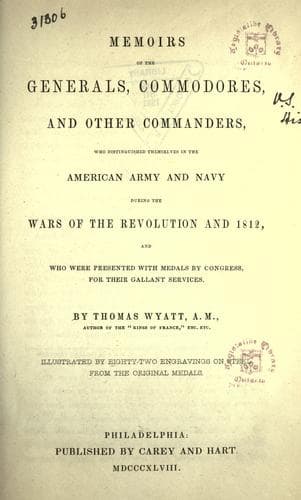
Memoirs of the Generals, Commodores and other Commanders, who distinguished themselves in the American army and navy during the wars of the Revolution and 1812, and who were presented with medals by Congress for their gallant servicesWyatt, Thomas
History
Memoirs of the Generals, Commodores and other Commanders, who distinguished themselves in the American army and navy during the wars of the Revolution and 1812, and who were presented with medals by Congress for their gallant services
Wyatt, Thomas
United States -- History -- Revolution, 1775-1783 -- Biography; United States -- History -- Revolution, 1775-1783 -- Medals; United States -- History -- War of 1812 -- Biography; United States -- History -- War of 1812 -- Medals
Washington, in order to save Philadelphia, with the main army fell
back and crossed the Schuylkill at Parker’s ferry, leaving General
Wayne with about fifteen hundred men to watch the enemy, who had
retreated back about three miles. After remaining at that post for four
days, he was apprised of the near approach of the British army, and
after giving three distinct orders to one of his colonels to lead off
by another road and attack the enemy in the rear, which order was not
understood, and consequently not obeyed, gave the British time to come
upon them before they could make good their retreat. The enemy fell
upon them with the cry of “No quarters,” and one hundred and fifty of
his brave men were killed and wounded in this barbarous massacre. The
next battle at which this valiant soldier distinguished himself, was
at Germantown. The British having taken a position in the immediate
vicinity of that village, General Wayne, moving with much secrecy,
attacked them in their camp at the dawn of day, but after many hours of
hard fighting and a succession of untoward circumstances, was obliged
to retreat. The loss of the Americans in this action, was one hundred
and fifty-two killed, five hundred and twenty-one wounded, and four
hundred taken prisoners; the loss of the British was eight hundred
killed and wounded.
The British army remained in nearly the same position till the 26th
of October, when General Howe, with a detachment of his troops,
took peaceable possession of Philadelphia. _Watson, in his Annals
of Philadelphia, says_,--“As they entered the city, Lord Cornwallis
at their head led the van. They marched down Second street without
any huzzaing or insolence whatever, and the citizens thronged the
sidewalks with serious countenances, looking at them. The artillery
were quartered in Chestnut street, between Third and Sixth streets. The
State House yard was made use of as a parade ground.”
Congress had previously been removed to Lancaster, in the interior
of the state, sixty miles from Philadelphia. Washington and his army
were posted at White Marsh, about fourteen miles from Philadelphia,
and in order to draw the commander-in-chief from his strong position,
the British general, Howe, marched his soldiers to the neighborhood of
the American lines, and after many demonstrations of attack, finding
that Washington was not disposed to bring on another action, retreated
again to the city. This gave Washington an opportunity of proceeding to
Valley Forge, where, in the month of December, with his almost famished
and naked soldiers, they cheerfully commenced building huts with their
own hands in the woods. Early in January, General Wayne repaired to
Lancaster, where the government was then located, to use his exertions
in raising supplies, both of provisions and clothing, for the army.
Reviews
Reviews
No reviews yet
Be the first to share your thoughts on this work.
Join the Discussion
Join the discussion
Sign in to leave a comment or review.
Sign InorCreate an account