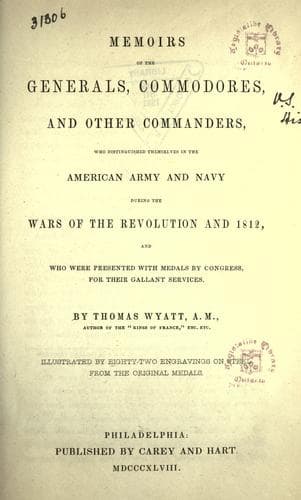
Memoirs of the Generals, Commodores and other Commanders, who distinguished themselves in the American army and navy during the wars of the Revolution and 1812, and who were presented with medals by Congress for their gallant services — John Shaqi
Memoirs of the Generals, Commodores and other Commanders, who distinguished themselves in the American army and navy during the wars of the Revolution and 1812, and who were presented with medals by Congress for their gallant servicesWyatt, Thomas
History
Memoirs of the Generals, Commodores and other Commanders, who distinguished themselves in the American army and navy during the wars of the Revolution and 1812, and who were presented with medals by Congress for their gallant services
Wyatt, Thomas
United States -- History -- Revolution, 1775-1783 -- Biography; United States -- History -- Revolution, 1775-1783 -- Medals; United States -- History -- War of 1812 -- Biography; United States -- History -- War of 1812 -- Medals
REVERSE.--A fort, with two turrets, on the top of a hill: the British
flag flying: troops in single or Indian file, advancing in the front
and rear up the hill: numbers lying at the bottom. Troops advancing in
front, at a distance, on the edge of the river: another party to the
right of the fort. A piece of artillery posted on the plain, so as to
bear upon the fort; ammunition on the ground: six vessels in the river.
LEGEND.--Stony Point expugnatum.
EXERGUE.--15th July, 1779.
[Illustration: Plate 2.
3
4
5
_W. L. Ormsby, sc._]
MAJ. JOHN STEWART.
It is a singular fact that no biographical memoir can be found of this
gallant officer.
By the journals of Congress for July 26, 1779, we find, that that body
passed a unanimous vote of thanks to General Wayne, and the officers
and soldiers, whose bravery was so conspicuous at the memorable attack
on Stony Point; particularly mentioning Colonel De Fleury and Major
Stewart, as having led the attacking columns, under a tremendous fire.
By the same resolve of Congress, we find, that a medal, descriptive of
that action, was ordered to be struck and presented to Major Stewart.
(_See_ Plate II.)
In a communication soon after the close of the war, it says, that
Major Stewart was killed by a fall from his horse, near Charleston,
South Carolina. Should this meet the eye of any of the representatives
of the late Major Stewart, the publishers of these memoirs would feel
grateful for any particulars respecting that distinguished officer, as
they may be added in another edition.
DESCRIPTION OF THE MEDAL.
OCCASION.--Taking the fort of Stony Point.
DEVICE.--America, personified in an Indian queen, is presenting a palm
branch to Captain Stewart: a quiver hangs at her back: her bow and
an alligator at her feet: with her left hand she supports a shield
inscribed with the American stripes, and resting on the ground.
LEGEND.--Johanni Stewart cohortis prefecto comitia Americus.
REVERSE.--A fortress on an eminence: in the foreground, an officer
cheering his men, who are following him over a _battis_ with charged
bayonets in pursuit of a flying enemy; troops in Indian files ascending
the hill to the storm, front and rear: troops advancing from the shore:
ships in sight.
EXERGUE.--Stony Point oppugnatum, 15th July, 1779.
LIEUT.-COL. DE FLEURY.
Very little is known of the hero of the following memoir previous to
his leaving his native country. He was educated as an engineer, and
brought with him to this country testimonials of the highest order.
His family were of the French noblesse; his ancestor, Hercule André de
Fleury, was canon of Montpelier, and appointed by Louis XIV. preceptor
to his grandson. At the age of seventy years he was made cardinal and
prime minister, and by his active and sagacious measures the kingdom of
France prospered greatly under his administration.
Reviews
Reviews
No reviews yet
Be the first to share your thoughts on this work.
Join the Discussion
Join the discussion
Sign in to leave a comment or review.
Sign InorCreate an account