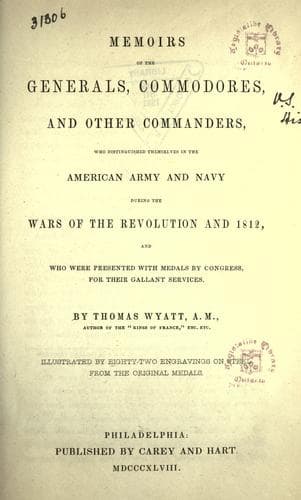
Memoirs of the Generals, Commodores and other Commanders, who distinguished themselves in the American army and navy during the wars of the Revolution and 1812, and who were presented with medals by Congress for their gallant servicesWyatt, Thomas
History
Memoirs of the Generals, Commodores and other Commanders, who distinguished themselves in the American army and navy during the wars of the Revolution and 1812, and who were presented with medals by Congress for their gallant services
Wyatt, Thomas
United States -- History -- Revolution, 1775-1783 -- Biography; United States -- History -- Revolution, 1775-1783 -- Medals; United States -- History -- War of 1812 -- Biography; United States -- History -- War of 1812 -- Medals
De Fleury, the subject of this brief sketch, was pursuing his
profession when the news of the American revolution reached the shores
of France. Endowed by nature with a spirit of independence, vigorous
intellect, undaunted courage, and a spirit of enterprise, he seemed
peculiarly fitted to encounter perils and hardships, which his daring,
prompt and skillful maneuvers, in some of the sharpest battles of the
revolution, proved most true. He read with excited anxiety, again and
again, of the oppression and tyranny exercised by the mother country
against the colonies.
Next came the news that at once decided our young hero on embarking
for America; the colonies had actually revolted, had thrown off
the yoke of tyranny and usurpation, declaring themselves a free
and independent people. This was a struggle, but it must be
conquered. De Fleury reached the shores of America, was received by
the Commander-in-chief, received a commission, and commenced his
revolutionary campaign, to which he adhered with that unflinching
constancy which leaves no doubt of the purity and disinterestedness
of his motives. Soon after the battle of Brandywine our hero was
dispatched to Fort Mifflin in the capacity of engineer, described in
the following letter from General Washington to Lieutenant-Colonel
Samuel Smith, in which he says:--“Enclosed is a letter to Major Fleury,
whom I ordered to Fort Mifflin to serve in quality of engineer. As
he is a young man of talents, and has made this branch of military
service his particular study, I place confidence in him. You will,
therefore, make the best arrangement for enabling him to carry such
plans into execution as come within his department. His authority,
at the same time that it is subordinate to yours, must be sufficient
for putting into practice what his knowledge of fortification points
out as necessary for defending the post; and his department, though
inferior, being of a distinct and separate nature, requires that his
orders should be in a great degree discretionary, and that he should
be suffered to exercise his judgment. Persuaded that you will concur
with him in every measure, which the good of the service may require, I
remain,” &c.
For six days previous to the evacuation of Fort Mifflin, the fire
from the enemy’s batteries and shipping had been incessant. Major
Fleury kept a journal of events, which were daily forwarded to General
Washington, from which the following are extracts.
“November 10th, _at noon_.--I am interrupted by the bombs and balls,
which fall thickly. The firing increases, but not the effect; our
barracks alone suffer. _Two o’clock_:--the direction of the fire is
changed; our palisades suffer; a dozen of them are broken down; one of
our cannon is damaged; I am afraid it will not fire straight. _Eleven
o’clock at night_:--the enemy keep up a firing every half hour. Our
garrison diminishes; our soldiers are overwhelmed with fatigue.
Public-domain text, read in full here on John Shaqi.
Reviews
Reviews
No reviews yet
Be the first to share your thoughts on this work.
Join the Discussion
Join the discussion
Sign in to leave a comment or review.
Sign InorCreate an account