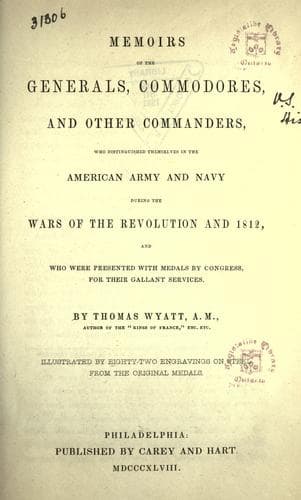
Memoirs of the Generals, Commodores and other Commanders, who distinguished themselves in the American army and navy during the wars of the Revolution and 1812, and who were presented with medals by Congress for their gallant services — John Shaqi
Memoirs of the Generals, Commodores and other Commanders, who distinguished themselves in the American army and navy during the wars of the Revolution and 1812, and who were presented with medals by Congress for their gallant servicesWyatt, Thomas
History
Memoirs of the Generals, Commodores and other Commanders, who distinguished themselves in the American army and navy during the wars of the Revolution and 1812, and who were presented with medals by Congress for their gallant services
Wyatt, Thomas
United States -- History -- Revolution, 1775-1783 -- Biography; United States -- History -- Revolution, 1775-1783 -- Medals; United States -- History -- War of 1812 -- Biography; United States -- History -- War of 1812 -- Medals
“11th. The enemy keep up a heavy fire; they have changed the direction
of their embrasures, and instead of battering our palisades in front,
they take them obliquely and do great injury to our north side. _At
night_:--the enemy fire and interrupt our works. Three vessels have
passed up between us and Province Island, without any molestation from
the galleys. Colonel Smith, Captain George, and myself wounded. These
two gentlemen passed immediately to Red Bank.
“12th. Heavy firing; our two eighteen pounders at the northern battery
dismounted. _At night_:--the enemy throw shells, and we are alarmed by
thirty boats.
“13th. The enemy have opened a battery on the old Ferry Wharf; the walk
of our rounds is destroyed, the block-houses ruined. Our garrison is
exhausted with fatigue and ill-health.
“14th. The enemy have kept up a firing upon us part of the night.
Day-light discovers to us a floating battery, placed a little above
their grand battery and near the shore. _Seven o’clock_:--the enemy
keep up a great fire from their floating battery and the shore; our
block-houses are in a pitiful condition. _At noon_:--we have silenced
the floating battery. A boat, which this day deserted from the fleet,
will have given the enemy sufficient intimation of our weakness; they
will probably attempt a lodgment on the Island, which we cannot prevent
with our whole strength.
“15th--_at six in the afternoon_.--The fire is universal from the
shipping and batteries. We have lost a great many men to-day; a great
many officers are killed or wounded. My fine company of artillery is
almost destroyed. We shall be obliged to evacuate Fort Mifflin this
night. Major Talbut is badly wounded.
“16th. We were obliged to evacuate the fort last evening. Major Thayer
returned from thence a little after two this morning. Everything was
got off that possibly could be. The cannon could not be removed without
making too great a sacrifice of men, as the Vigilant lay within one
hundred yards of the southern part of the works, and with her incessant
fire, hand grenades and musketry, from the round-top, killed every man
that appeared upon the platforms.”
After this devastating conflict, Fleury was promoted to the rank of
lieutenant-colonel in the army. He had already received from Congress
the gift of a horse, as a testimonial of their sense of his merit at
the battle of Brandywine, where a horse was shot under him.
“To the President of Congress--
“_Head Quarters, West Point, 25th July, 1779._
Reviews
Reviews
No reviews yet
Be the first to share your thoughts on this work.
Join the Discussion
Join the discussion
Sign in to leave a comment or review.
Sign InorCreate an account