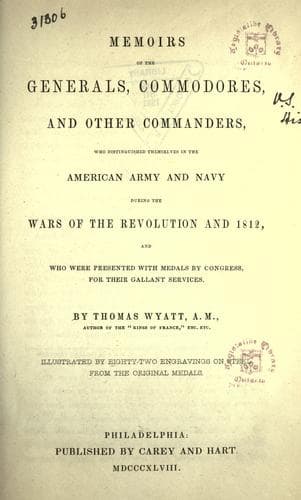
Memoirs of the Generals, Commodores and other Commanders, who distinguished themselves in the American army and navy during the wars of the Revolution and 1812, and who were presented with medals by Congress for their gallant servicesWyatt, Thomas
History
Memoirs of the Generals, Commodores and other Commanders, who distinguished themselves in the American army and navy during the wars of the Revolution and 1812, and who were presented with medals by Congress for their gallant services
Wyatt, Thomas
United States -- History -- Revolution, 1775-1783 -- Biography; United States -- History -- Revolution, 1775-1783 -- Medals; United States -- History -- War of 1812 -- Biography; United States -- History -- War of 1812 -- Medals
North River, he commanded one of the attacks, was the first
that entered the main works, and struck the British flag with
his own hands.
G. WASHINGTON.
In July, 1779, Congress passed a vote of thanks to Colonel De Fleury,
with a gold medal (_see_ Plate II.) for his bravery and courage at
Stony Point. During the two years De Fleury was attached to the
American army, he took a conspicuous post in all the battles fought
within that period; and such was his bravery, that every commander
under whom he had the honor to serve, recommended him to the especial
notice of Congress.
MEDAL.
OCCASION.--Taking the fort of Stony Point.
DEVICE.--A soldier helmeted and standing against the ruins of a fort:
his right hand extended, holding a sword upright: the staff of a stand
of colors reversed in his left: the colors under his feet: his right
knee drawn up, as if in the act of stamping on them.
LEGEND.--Virtutis et audiciæ monum, et præmium D. De Fleury equiti
gallo primo muros resp. Americ. d. d.
REVERSE.--Two water batteries, three guns each: one battery firing at
a vessel: a fort on a hill: flag flying: river in front: six vessels
before the fort.
LEGEND.--Aggeres paludes hostes victi.
EXERGUE.--Stony Pt. expugn. 15th July, 1779.
CAPTURE OF MAJ. ANDRE.
John Andre, a British officer, was clerk in a mercantile house in
London; being anxious for a military life, he obtained a commission
as ensign in the regiment commanded by Sir Henry Clinton, then about
to embark for America. His energetic and enterprising spirit soon
raised him to the rank of major and aid-de-camp to Sir Henry. Benedict
Arnold, the American traitor, a man guilty of every species of artifice
and deception, smarting under the inflictions of a severe reprimand
from his superiors, for misconduct, was resolved to be revenged by
the sacrifice of his country. By artifice he obtained command of the
important post of West Point. He had previously, in a letter to the
British commander, signified his change of principles, and his wish to
join the royal army. A correspondence now commenced between him and Sir
Henry Clinton, the object of which was to concert the means of putting
West Point into the hands of the British. The plot was well laid,
correct plans of the fort drawn, and as they supposed, the execution
certain. The arrangement was effected by Major John Andre, aid-de-camp
to Sir Henry Clinton, and adjutant-general of the British army. Andre,
who had effected all the arrangements with Arnold, received from him a
pass, authorizing him, under the feigned name of Anderson, to proceed
on the public service to the White Plains, or lower, if it was required.
He had passed all the guards and posts on the road without suspicion,
and was proceeding, with the delicate negotiation, to Sir Henry, who
was then in New York.
Reviews
Reviews
No reviews yet
Be the first to share your thoughts on this work.
Join the Discussion
Join the discussion
Sign in to leave a comment or review.
Sign InorCreate an account