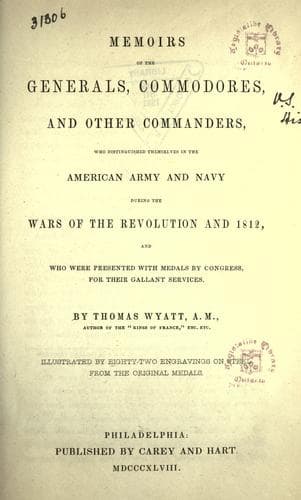
Memoirs of the Generals, Commodores and other Commanders, who distinguished themselves in the American army and navy during the wars of the Revolution and 1812, and who were presented with medals by Congress for their gallant servicesWyatt, Thomas
History
Memoirs of the Generals, Commodores and other Commanders, who distinguished themselves in the American army and navy during the wars of the Revolution and 1812, and who were presented with medals by Congress for their gallant services
Wyatt, Thomas
United States -- History -- Revolution, 1775-1783 -- Biography; United States -- History -- Revolution, 1775-1783 -- Medals; United States -- History -- War of 1812 -- Biography; United States -- History -- War of 1812 -- Medals
Having arrived within a few miles of Tarrytown, he was accosted by
three individuals who appeared loitering on the road. One of them
seized the reins of his bridle, while another in silence pointed a
rifle to his breast. Andre exclaimed, “Gentlemen, do not detain me;
I am a British officer on urgent business; there is my pass,” at the
same time drawing from his breast a paper, which he handed to one of
the three, while the other two, looking with anxious scrutiny over the
shoulders of their comrades, read as follows:--
_Head Quarters, Robinson’s House, Sept. 22d, 1780._
Permit Mr. John Anderson to pass the guards to the White
Plains, or below, if he chooses. He being on public business by
my direction.
B. ARNOLD, _M. Gen’l._
Andre made a second effort to be dismissed; when one of the men
requested to know, how a British officer came in possession of a pass
from an American general. A notice appeared some time since, purporting
to be from a person who had remembered the circumstance, and an actual
acquaintance of Paulding, Van Wart and Williams, that Paulding wore a
British uniform, which accounted for the fatal mistake made by Andre,
in so quickly declaring himself to be a British officer. The three
militia men insisted upon Andre’s dismounting, which he did. They then
led him to the side of the road, and told him he must divest himself
of his clothing, in order to give them an opportunity to search him.
This was done with reluctance, after offering his splendid gold watch,
his purse, nay thousands, to be permitted to pass; but no bribe could
tempt, no persuasion could allure: they were Americans! Paulding, Van
Wart and Williams had felt the hand of British wrong; they had been
robbed, ill-treated, and trampled on, and would sooner suffer death
than aid the enemy of Washington.
This, then, was the appalling moment. Andre knew that all must be
divulged. He had but one hope, that their ignorance might prevent their
being able to read the papers contained in his boot. In this he was
mistaken, for Paulding first seizing the papers, read them aloud to his
comrades in a bold voice. Nothing can picture the terrible treachery,
which, to their uneducated minds, was planned in these papers.
Andre was speechless, and as pale as death. His fortitude seemed to
forsake him; and laying his hands on Paulding’s arms, exclaimed, in
tones of pity not to be described, “Take my watch, my horse, my purse,
all! all I have--only let me go!” But no! the stern militia men could
not be coaxed or bribed from their duty to their country. By a court
martial ordered by General Washington, Andre was tried, found guilty,
and agreeably to the law of nations, sentenced to suffer death.
Though he requested to die like a soldier, the ignominious sentence of
being hung was executed upon him the 2d of October, 1780, at the early
age of twenty-nine years.
Public-domain text, read in full here on John Shaqi.
Reviews
Reviews
No reviews yet
Be the first to share your thoughts on this work.
Join the Discussion
Join the discussion
Sign in to leave a comment or review.
Sign InorCreate an account