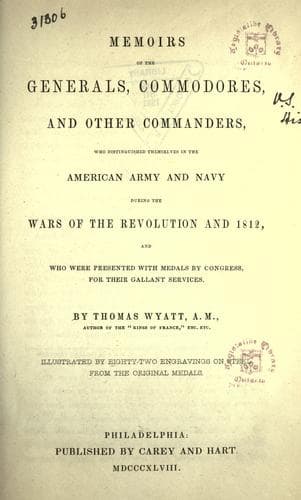
Memoirs of the Generals, Commodores and other Commanders, who distinguished themselves in the American army and navy during the wars of the Revolution and 1812, and who were presented with medals by Congress for their gallant services — John Shaqi
Memoirs of the Generals, Commodores and other Commanders, who distinguished themselves in the American army and navy during the wars of the Revolution and 1812, and who were presented with medals by Congress for their gallant servicesWyatt, Thomas
History
Memoirs of the Generals, Commodores and other Commanders, who distinguished themselves in the American army and navy during the wars of the Revolution and 1812, and who were presented with medals by Congress for their gallant services
Wyatt, Thomas
United States -- History -- Revolution, 1775-1783 -- Biography; United States -- History -- Revolution, 1775-1783 -- Medals; United States -- History -- War of 1812 -- Biography; United States -- History -- War of 1812 -- Medals
On the night of the 25th of December, 1776, General Greene crossed
the Delaware, and in command of the left wing of the army, surprised
the enemy at Trenton, seized their artillery, and prevented their
retreat to Princeton. He never left the army during the following
winter, but bore his share in its hardships and glories. He commanded
the left wing of the American army at the battle of Germantown. “Such
was the distressed situation of the American army through the winter
of that year, that Washington was doubtful of his ability to take the
field the ensuing season. Every exertion was made to put the army in a
condition for the campaign, and General Greene was urged to accept the
appointment of quarter-master general. The office was accepted with
great reluctance, for his inclination was to serve in the line; and
the charge and disbursing the public money was to him of all things
unpleasant. The necessities of the army, however, and the strong
expression of Washington, that ‘some one must make the sacrifice,’
at last induced him to consent; but not until the condition was
acceded, that he should not lose his right to command in action. Of
this he availed himself at the battles of Monmouth, and on the retreat
from Rhode Island. The duties of his new station were arduous and
embarrassing, but were rendered more so by the unhappy factions which
divided the councils of the country. Notwithstanding the distress and
poverty which threatened ruin to the cause, intrigue and slander were
in active operation, to undermine the reputation and character of the
men who were devoting themselves to accomplish the almost hopeless
work. Washington himself was assailed; and Greene, who was supposed to
have been his favorite officer and confidential adviser, was made an
object of suspicion; but the purity and integrity of General Greene’s
character bore him above the storm.--Congress did him justice, and his
personal friends never faltered in the discharge of their duty towards
him.” In 1780, General Greene was appointed to the command of the
southern department; on his arrival at Charlotte, he found the southern
army destitute of almost everything: no artillery, baggage or stores.
In a letter to Lafayette, he says:--“Were you to arrive now, you would
find a few ragged, half-starved troops in the wilderness, destitute of
everything necessary for the comfort or convenience of soldiers.”
He had arrived in an exhausted country, the inhabitants divided into
hostile parties, and an enemy before him, well provided, and flushed
with the prospect of victory.
His only dependence and hope of success were in a number of spirited
and devoted officers, who gathered around him, and the promise of
reinforcements from the states he had passed through during his route.
General Greene thought it most prudent to remove to a place where
subsistence and the means of transportation could be obtained.
Reviews
Reviews
No reviews yet
Be the first to share your thoughts on this work.
Join the Discussion
Join the discussion
Sign in to leave a comment or review.
Sign InorCreate an account