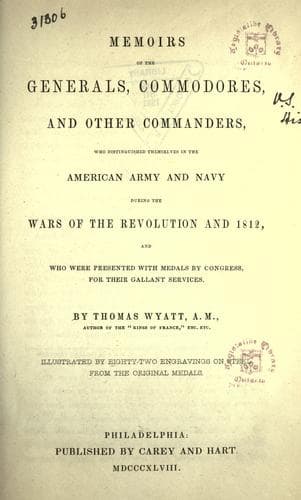
Memoirs of the Generals, Commodores and other Commanders, who distinguished themselves in the American army and navy during the wars of the Revolution and 1812, and who were presented with medals by Congress for their gallant servicesWyatt, Thomas
History
Memoirs of the Generals, Commodores and other Commanders, who distinguished themselves in the American army and navy during the wars of the Revolution and 1812, and who were presented with medals by Congress for their gallant services
Wyatt, Thomas
United States -- History -- Revolution, 1775-1783 -- Biography; United States -- History -- Revolution, 1775-1783 -- Medals; United States -- History -- War of 1812 -- Biography; United States -- History -- War of 1812 -- Medals
He accordingly marched to the Cheraw hills, on the Pee Dee; and
detached General Morgan to the west of the Catawba, to cut off the left
wing of Cornwallis’ army, and otherwise annoy him as circumstances
might permit. This movement of General Morgan and his army alarmed
the British from their posts. Colonel Tarleton was dispatched with
a force to cut off and destroy him; but in this case the victory
took an opposite direction, and Colonel Tarleton’s troops met their
annihilation at the Cowpens. The news of this victory was a severe blow
to Cornwallis, and he at once determined to cut off Morgan’s retreat
with his prisoners, and prevent his joining the main army. But in this
he was foiled; for, mistaking the route supposed to be taken by his
enemy, Morgan was enabled to reach Greene in safety. Notwithstanding
the victory at the Cowpens, General Greene had to encounter a number
of successive disasters. He was defeated at Guildford, and again at
Camden, but prevented Lord Rawdon from improving his success, and
obliged him to retire beyond the Santee. While in the vicinity of the
Santee, he was under the painful necessity of ordering the sentence
of the law to be put in force on some of his men. From the continual
desertions taking place, he found it necessary to hang eight of
his soldiers in one day. A number of forts and garrisons in South
Carolina now fell into his hands, but the army, at the approach of
Lord Rawdon, was under the necessity of retreating to the extremity
of the state. Discouraging as this was, the firmness and decision of
General Greene sustained him through every trial. Being at this time
advised to abandon South Carolina and retire to Virginia, he replied,
“I will recover the country or perish in the attempt.” Lord Rawdon soon
found that pursuit was hazardous, and retired to Charleston. General
Greene retired to the Santee Hills, to enjoy the breezes during the
debilitating heat of the summer months. An able historian gives the
following account of the battle at Eutaw Springs, which was the last
of General Greene’s battles:--“The battle at the Eutaw Springs, on the
8th of September, was described by the American commander, as the most
obstinate and bloody he had ever seen. The militia, with a firmness
‘which would have graced the veterans of the great King of Prussia,’
advanced with shouts into the hottest of the enemy’s fire; but one
part of the line faltering for a moment, the British, elated at the
prospect, sprang forward to improve that moment, but at the same time
deranged their own line. General Greene, who was watching for such an
incident, ‘ordered the second line to advance and sweep the field with
the bayonets!’
Reviews
Reviews
No reviews yet
Be the first to share your thoughts on this work.
Join the Discussion
Join the discussion
Sign in to leave a comment or review.
Sign InorCreate an account