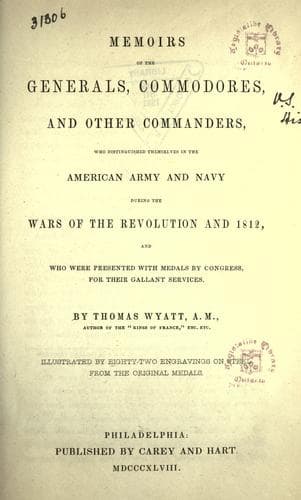
Memoirs of the Generals, Commodores and other Commanders, who distinguished themselves in the American army and navy during the wars of the Revolution and 1812, and who were presented with medals by Congress for their gallant servicesWyatt, Thomas
History
Memoirs of the Generals, Commodores and other Commanders, who distinguished themselves in the American army and navy during the wars of the Revolution and 1812, and who were presented with medals by Congress for their gallant services
Wyatt, Thomas
United States -- History -- Revolution, 1775-1783 -- Biography; United States -- History -- Revolution, 1775-1783 -- Medals; United States -- History -- War of 1812 -- Biography; United States -- History -- War of 1812 -- Medals
LEGEND.--Salus regionem australium.
EXERGUE.--Hostibus ad Eutaw debellatis, die 8th Sept. 1781.
GEN. HORATIO GATES.
Horatio Gates was the son of a clergyman at Malden, in England, and was
born in the year 1729. Having lost his father at an early age, he was
left pretty much to the dictates of his own passion. He appears to have
determined on a military life as early as twelve years of age, when
the frequent remonstrances of his uncle and guardian could not prevail
on him to relinquish the thoughts of a profession so much against the
wishes of his family.
At the age of seventeen he was appointed to an ensigncy in the
regiment commanded by General Monckton, who was a personal friend of
the father of Gates, and who gave him every opportunity of improving
himself. Shortly after he was promoted to a lieutenancy, and was
aid-de-camp to General Monckton at the capture of Martinico, where his
bravery and soldier-like conduct won for him the rank of major. He was
among the first troops who landed at Halifax, in Nova Scotia, under
General Cornwallis, and was stationed there for some time. He was only
in his twenty-sixth year when he accompanied the unfortunate Braddock
in the expedition against Fort du Quesne, and with the illustrious
Washington, was among the few officers, who, on that occasion,
escaped with their lives. Gates did not escape, however, without a
very dangerous wound; he was shot through the body, which for a time
shut him out from the bloody and perilous scenes which attended the
various battles of the French war. Although he had not been a citizen
of the new world but a few years, he evinced his attachment to it by
purchasing a farm in Virginia, where he retired till he was perfectly
restored to health. His attachment to the new country, and a military
reputation so high, Congress, without any hesitation, appointed him
adjutant-general, with the rank of brigadier-general in the new army
of the revolution of 1775. General Washington was well acquainted with
his merits in his military character, and warmly recommended him to
Congress on the occasion; they had been fellow-soldiers and sufferers
under General Braddock.
From this period he took an active part in most of the transactions
of the war, and his bravery and good fortune placed him in a rank
inferior only to Washington. In July, 1775, he accompanied the
commander-in-chief to Cambridge, and was employed for some time in a
subordinate but highly useful capacity. In June, 1776, the government
evinced their confidence in Gates, by conferring on him the chief
command of the forces at the north, and the new general was found in
no way deficient in courage and vigilance, so necessary under such
circumstances.
Reviews
Reviews
No reviews yet
Be the first to share your thoughts on this work.
Join the Discussion
Join the discussion
Sign in to leave a comment or review.
Sign InorCreate an account