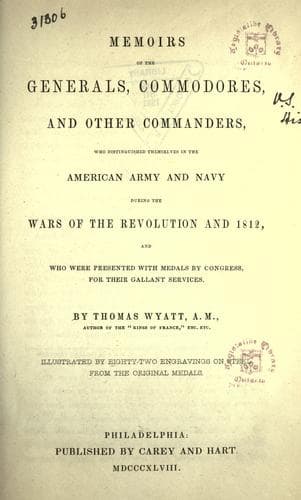
Memoirs of the Generals, Commodores and other Commanders, who distinguished themselves in the American army and navy during the wars of the Revolution and 1812, and who were presented with medals by Congress for their gallant servicesWyatt, Thomas
History
Memoirs of the Generals, Commodores and other Commanders, who distinguished themselves in the American army and navy during the wars of the Revolution and 1812, and who were presented with medals by Congress for their gallant services
Wyatt, Thomas
United States -- History -- Revolution, 1775-1783 -- Biography; United States -- History -- Revolution, 1775-1783 -- Medals; United States -- History -- War of 1812 -- Biography; United States -- History -- War of 1812 -- Medals
The Congress had turned an anxious eye towards Canada at the opening
of the contest; being fully aware of the danger of their gaining
possession of our harbors and lakes, and the great difficulty to us,
to obtain possession of their strong forts on their settled frontier.
The British commenced the naval preparations on their side with great
alacrity and success. But the Americans had every obstacle, but the
want of zeal, to encounter in preparing for defence. General Gates
was directed to co-operate with General Schuyler, but there was a
miserable and irreparable deficiency in cannon, in the materials of
ship-building, and even in the necessary workmen. The country had
been hitherto a desert. Colonization, in its natural progress, had
not approached these solitary shores. Nothing but the exigencies of
the former war with France had occasioned this region to be traversed
or inhabited. A few forts, with suitable garrisons, were all that
could be found in it, and that abundance of workmen, vessels and
prepared timber, which a well-planted country would have spontaneously
furnished, was unknown. Schuyler, indeed, was not destitute of a naval
armament, but it was insufficient to cope with the greater preparations
of the enemy. With all the exertions of the two commanders, they
were merely able to equip about fifteen vessels, half of which were
little better than boats, and the largest carried only twelve small
guns very ill supplied with ammunition. This small armament, at the
recommendation of General Gates, was placed under the command of the
intrepid, and then, unsuspected Arnold. The first operations of the
campaign consisted in a contest between these vessels under Arnold, and
a much superior force under General Carleton, in which the land forces
had no concern. The British army under Carleton commenced their advance
to Ticonderoga, where Gates and Schuyler were already stationed with
eight thousand men, well provisioned and determined to defend it to the
last extremity; all parties expecting to witness a long, obstinate,
and, perhaps, a bloody siege.
Some causes, however, and most probably the lateness of the season,
induced Carleton to disappoint these expectations, by precipitately
retiring to Canada in search of winter quarters.
This retreat enabled General Gates to march southward, with a
considerable detachment of his army, to assist General Washington in
his operations in the middle colonies. The ensuing year was passed in a
great variety of movements and skirmishes in the lower districts of New
York, Pennsylvania and Jersey, between detachments of each army. In the
ordinary records of the time, we meet with no splendid or conspicuous
part performed by the subject of these memoirs, though there is
sufficient reason to believe that his services in that motley warfare
were active, strenuous and useful.
Reviews
Reviews
No reviews yet
Be the first to share your thoughts on this work.
Join the Discussion
Join the discussion
Sign in to leave a comment or review.
Sign InorCreate an account