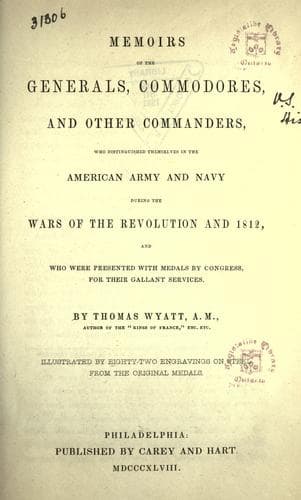
Memoirs of the Generals, Commodores and other Commanders, who distinguished themselves in the American army and navy during the wars of the Revolution and 1812, and who were presented with medals by Congress for their gallant servicesWyatt, Thomas
History
Memoirs of the Generals, Commodores and other Commanders, who distinguished themselves in the American army and navy during the wars of the Revolution and 1812, and who were presented with medals by Congress for their gallant services
Wyatt, Thomas
United States -- History -- Revolution, 1775-1783 -- Biography; United States -- History -- Revolution, 1775-1783 -- Medals; United States -- History -- War of 1812 -- Biography; United States -- History -- War of 1812 -- Medals
At the time our hero was born, all the planters throughout this county
were his relations--hence his youthful years glided away in all the
pleasing gayety of social friendship. In the tenth year of his age he
lost an excellent father, who died in 1742, and the patrimonial estate
devolved to an elder brother. This young gentleman had been an officer
in the colonial troops, sent in the expedition against Carthagena.
On his return, he called the family mansion Mount Vernon, in honor
of the British admiral with whom he sailed. George Washington, when
only fifteen years of age, ardent to serve his country, then at war
with France and Spain, solicited the post of midshipman in the British
navy, but the interference of a fond mother suspended, and for ever
diverted him from the navy. His devoted parent lived to see him acquire
higher honors than he ever could have obtained as a naval officer; but
elevated to the first offices, both civil and military, in the gift
of his country. She, from long established habits, would often regret
the side her son had taken in the controversy between her king and her
country. The first proof that he gave of his propensity to arms, was
in the year 1751, when the office of adjutant-general of the Virginia
militia became vacant by the death of his brother, and Mount Vernon,
with other estates, came into his possession. Washington, in his
twentieth year, was made major of one of the militia corps of Virginia.
The population made it expedient to form three divisions. When he was
but just twenty-one, he was employed by the government of his native
colony, in an enterprise which required the prudence of age as well as
the vigor of youth. In the year 1753, the encroachments of the French
upon the western boundaries of the British colonies, excited such
general alarm in Virginia, that Governor Dinwiddie deputed Washington
to ascertain the truth of these rumors; he also was empowered to enter
into a treaty with the Indians, and remonstrate with the French upon
their proceedings.
On his arrival at the back settlements, he found the colonists in a
very unhappy situation, from the depredations of the Indians, who were
incessantly instigated by the French to the commission of continual
aggressions. He found that the French had actually established posts
within the boundaries of Virginia. Washington strongly remonstrated
against such acts of hostility, and in the name of his executive,
warned the French to desist from those incursions. On his return, his
report to the governor was published, and evinced that he had performed
this honorable mission with great prudence.
Reviews
Reviews
No reviews yet
Be the first to share your thoughts on this work.
Join the Discussion
Join the discussion
Sign in to leave a comment or review.
Sign InorCreate an account