Memoirs of the Generals, Commodores and other Commanders, who distinguished themselves in the American army and navy during the wars of the Revolution and 1812, and who were presented with medals by Congress for their gallant servicesWyatt, Thomas
History
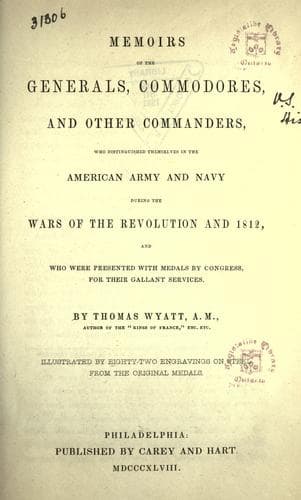
Memoirs of the Generals, Commodores and other Commanders, who distinguished themselves in the American army and navy during the wars of the Revolution and 1812, and who were presented with medals by Congress for their gallant services
Wyatt, Thomas
United States -- History -- Revolution, 1775-1783 -- Biography; United States -- History -- Revolution, 1775-1783 -- Medals; United States -- History -- War of 1812 -- Biography; United States -- History -- War of 1812 -- Medals
It was in consequence of the French calling themselves the first
European discoverers of the river Mississippi, that made them claim
all that immense region, whose waters run into that river. They were
proceeding to erect a chain of posts from Canada to the Ohio river,
thereby connecting Canada with Louisiana, and limiting the English
colonies to the east of the Alleghany mountains. The French were too
intent on their favorite project of extending their domain in America,
to be diverted from it by the remonstrances of a colonial governor.
This induced the Assembly of Virginia to raise a regiment of three
hundred men to defend their frontiers and maintain the right claimed by
their king.
Of this regiment, Professor Fry, of William and Mary College, was
appointed colonel, and George Washington lieutenant-colonel. Fry died
soon after the regiment was embodied, and was succeeded by our hero,
who paid unremitting attention to the discipline of his new corps. The
latter advanced with his regiment as far as Great Meadows, where he
received intelligence, by the return of his scouts whom he had sent on
to reconnoiter, that the enemy had built a fort, and stationed a large
garrison at Duquesne, now Pittsburgh. Having now arrived within fifty
miles of the French post, Washington held a council of war with the
other officers, but while they were deliberating, a detachment of the
French came in sight and obliged them to retreat to a savanna called
the Green Meadows. On an eminence in the savanna they began to erect a
small fortification, which he named Fort Necessity.
On this redoubt they raised two field-pieces. On the following
day they were joined by Captain McKay, with a company of regulars,
amounting now to about four hundred men. Scarcely had they finished
their entrenchments when an advanced guard of the French appeared in
sight, at which the Americans sallied forth, attacked and defeated
them; but the main body of the enemy, amounting to fifteen hundred men,
compelled them to retire to their fort.
The camp was now closely invested, and the Americans suffered severely
from the grape shot of the enemy, and the Indian rifles. Washington,
however, defended the works with such skill and bravery, that the
besiegers were unable to force the entrenchments. After a conflict of
ten hours, in which one hundred and fifty of the Americans were killed
and wounded, they were obliged to capitulate. They were permitted to
march out with the honors of war, to retain their arms and baggage,
and to march unmolested into the inhabited parts of Virginia. The
legislature of Virginia, impressed with a high sense of the bravery of
our young officer, voted their thanks to him and the officers under
his command, and three hundred pistoles to be distributed among the
soldiers engaged in this action.
Reviews
Reviews
No reviews yet
Be the first to share your thoughts on this work.
Join the Discussion
Join the discussion
Sign in to leave a comment or review.
Sign InorCreate an account