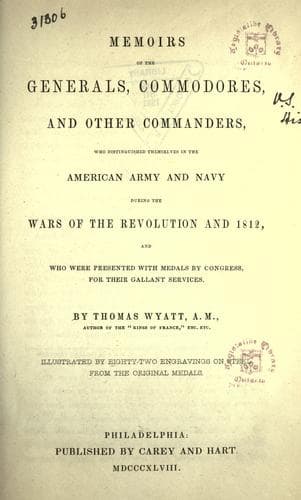
Memoirs of the Generals, Commodores and other Commanders, who distinguished themselves in the American army and navy during the wars of the Revolution and 1812, and who were presented with medals by Congress for their gallant servicesWyatt, Thomas
History
Memoirs of the Generals, Commodores and other Commanders, who distinguished themselves in the American army and navy during the wars of the Revolution and 1812, and who were presented with medals by Congress for their gallant services
Wyatt, Thomas
United States -- History -- Revolution, 1775-1783 -- Biography; United States -- History -- Revolution, 1775-1783 -- Medals; United States -- History -- War of 1812 -- Biography; United States -- History -- War of 1812 -- Medals
The English soldiery were panic-struck, the battery was carried
without resistance, the barrier left open, and the people gave
themselves up, asking for protection. Before entering the barrier
gate, he was ordered to wait for General Montgomery. In this he very
reluctantly acquiesced, saying at the same time that it would give
the enemy time to rally, and recover from their panic. In this he was
correct, for the news of the death of the brave Montgomery seemed
to damp the ardor of the brave soldiers; although they fought to
desperation, they were overwhelmed by numbers and made prisoners of
war. Soon after the exchange of Morgan, he received the appointment
of colonel in the continental army; and marched at the head of the
partisan rifle corps to the assistance of General Gates. At the
glorious victory of Saratoga, he took a most conspicuous part; although
Gates shamefully omitted to do him justice at the time, the English
account of the battle gave the principal credit of the victory to
Morgan.
A reconciliation, however, soon took place between Morgan and Gates;
and the latter, on every subsequent occasion, endeavored to make amends
for the injustice. The legislature of Virginia presented Morgan with
a horse, pistols and a sword; and his neighbors named his plantation
“Saratoga,” in honor of his late victory. His next act of bravery and
skill was displayed in the defeat of General Tarleton, at the battle of
the Cowpens, on the 17th of January, 1781, where he took nearly as many
prisoners as he had men of his own; and Congress testified the high
sense they entertained of this brilliant victory, by presenting him
with a gold medal, (hereafter described.) At the end of the war General
Morgan retired to his plantation at Saratoga, and devoted himself to
agricultural pursuits. He was elected to Congress, but after serving
two sessions, his debilitated health obliged him to retire from public
life.
In 1800, General Morgan removed to Winchester, where he was confined
by extreme debility for nearly two years, and expired on the sixth day
of July, 1802. General Morgan had two daughters, the eldest married to
the late General Presly Neville, of Pittsburgh, and the youngest to
Major Heard, of New Jersey. Of this gallant soldier it may truly be
said, that no officer rendered more efficient aid to the cause of his
country, and that he well merited the character at that time given him,
the hero of the three greatest victories, Quebec, Saratoga, and the
Cowpens.
DESCRIPTION OF THE MEDAL.
(_See_ Plate III.)
OCCASION.--Victory at the Cowpens, North Carolina.
DEVICE.--An Indian queen with a quiver on her back, in the act of
crowning an officer with a laurel wreath; his hand resting on his
sword: a cannon lying on the ground: various military weapons and
implements in the back-ground.
LEGEND.--Danieli Morgan, duci exercitus comitia Americana.
Reviews
Reviews
No reviews yet
Be the first to share your thoughts on this work.
Join the Discussion
Join the discussion
Sign in to leave a comment or review.
Sign InorCreate an account