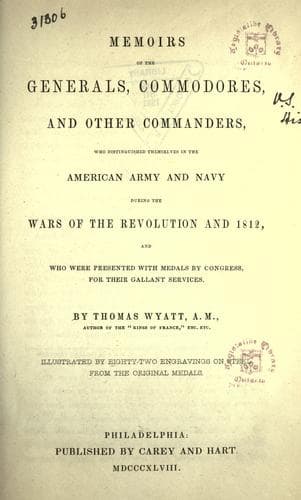
Memoirs of the Generals, Commodores and other Commanders, who distinguished themselves in the American army and navy during the wars of the Revolution and 1812, and who were presented with medals by Congress for their gallant servicesWyatt, Thomas
History
Memoirs of the Generals, Commodores and other Commanders, who distinguished themselves in the American army and navy during the wars of the Revolution and 1812, and who were presented with medals by Congress for their gallant services
Wyatt, Thomas
United States -- History -- Revolution, 1775-1783 -- Biography; United States -- History -- Revolution, 1775-1783 -- Medals; United States -- History -- War of 1812 -- Biography; United States -- History -- War of 1812 -- Medals
REVERSE.--An officer mounted, at the head of his troops, charging a
flying enemy. A battle in the back-ground: in front, a personal combat
between a dragoon unhorsed and a foot soldier.
LEGEND.--Victoria libertatis vindex.
EXERGUE.--Fugatis, captis aut cæsis ad cowpens hostibus, 17th January,
1781.
[Illustration: Plate 4.
9
10
11
_W. L. Ormsby, sc._]
JOHN EAGER HOWARD.
John Eager Howard, the subject of this memoir, was born on the 4th of
June, 1752, in Baltimore county, and state of Maryland. He was the
grandson of Joshua Howard, who, when young, left his home, in the
vicinity of Manchester, England, and against the wishes of his parents,
joined the army of the Duke of York, afterwards James the Second,
during Monmouth’s insurrection; fearing to encounter the displeasure
of his parents, he joined a band of adventurers, who were preparing to
seek their fortunes in the British colonies in North America, in the
year 1685.
He soon obtained a grant of land in Baltimore county, (which is still
held by the family,) and married Miss Joanna O’Carroll, of an Irish
family, but recently emigrated from Ireland.
Cornelius, his son, and father of the subject of this sketch, married
a Miss Eager, whose estate now forms part of the city of Baltimore.
During the interval that elapsed between the emigration of the early
members of the family to the revolution, they appear to have been quiet
cultivators of the soil, taking no part in the political broils that
were frequently arising in the colonies.
The time had now arrived, when every true son of America felt bound to
participate in the approaching struggle for liberty and independence,
and John Eager Howard received a commission as captain, in one of those
bodies of militia termed flying camps in the regiment commanded by
Colonel Hall. The commission depended upon his raising thirty men in a
given time; but such was the esteem in which our hero was held, that he
formed his company required in two days, and marched direct to the army.
In the following year he was promoted, till finally he succeeded
Lieutenant-Colonel Ford in the command of the second Maryland regiment.
He was present at the battle of White Plains, and continued to serve
till the end of the year 1776, when his corps was dismissed. Congress
having resolved to raise additional regiments to serve during the war,
with officers commissioned by Congress, Major Howard was one of the
number allotted to Maryland, and in April 1777, we find him marching
with his regiment to join the army at Rocky Hill, near Princeton, where
he remained till the latter end of June, when receiving information
of the death of his father, he returned home, till the following
September, when he rejoined the army a few days after the Battle at
Brandywine Springs, but in time to give proofs of his bravery at the
battle of Germantown, which afterwards so greatly distinguished him.
Public-domain text, read in full here on John Shaqi.
Reviews
Reviews
No reviews yet
Be the first to share your thoughts on this work.
Join the Discussion
Join the discussion
Sign in to leave a comment or review.
Sign InorCreate an account