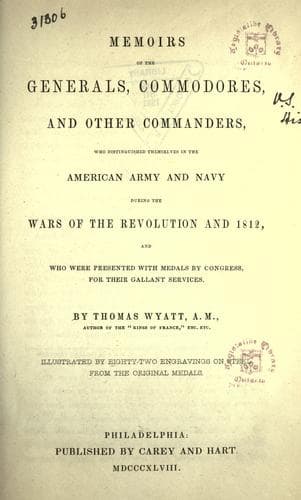
Memoirs of the Generals, Commodores and other Commanders, who distinguished themselves in the American army and navy during the wars of the Revolution and 1812, and who were presented with medals by Congress for their gallant servicesWyatt, Thomas
History
Memoirs of the Generals, Commodores and other Commanders, who distinguished themselves in the American army and navy during the wars of the Revolution and 1812, and who were presented with medals by Congress for their gallant services
Wyatt, Thomas
United States -- History -- Revolution, 1775-1783 -- Biography; United States -- History -- Revolution, 1775-1783 -- Medals; United States -- History -- War of 1812 -- Biography; United States -- History -- War of 1812 -- Medals
He was removed from the county school into an academy of repute
in Philadelphia, where he soon became an expert mathematician,
sufficiently so, that on his leaving school he became a land surveyor,
with a very respectable and lucrative business. At the persuasion of
Dr. Franklin, he removed to Nova Scotia, as agent for a company of
settlers about to repair to that province on a scheme of emigration.
As an able negotiator he acquitted himself honorably, and returned to
Pennsylvania, where he married the daughter of Benjamin Penrose, an
eminent merchant of Philadelphia, and settled once more on a farm in
his native county. The aspect of affairs between the mother country
and the provinces at this time convinced our young hero that desperate
means must soon be resorted to to prevent invasion from abroad and
insurrection at home. Satisfied that the controversies between the two
countries would only be adjusted by the sword, he determined to apply
himself to military discipline and tactics, that whenever his country
required it, he might devote his energies in raising and preparing
for the field a regiment of volunteers. The moment arrived, and young
Wayne was only six weeks in completing a regiment, of which he was
unanimously chosen colonel. At the sound of taxation the undaunted
spirit of liberty burst forth, and thousands of young and fearless
patriots thronged around the sacred banner to enrol themselves in a
cause which must eventually end in freedom. News of the opening of the
revolution at Bunker’s Hill and Lexington arrived, and Washington, who
had accepted the command of the army, repaired to the seat of war.
Congress, now sitting at Philadelphia, called upon the colonies for
regiments to reinforce the northern army, and the one raised by the
exertions of Anthony Wayne was the first called into service, and upon
him was conferred the command. His orders to join General Lee at New
York were quickly obeyed, whence he proceeded with his regiment to
Canada, to be stationed at the entrance of Sorel river.
Shortly after his arrival there, news arrived that a detachment of
six hundred British light infantry were advancing toward a post called
Trois Rivières (Three Rivers). Anxious to check their advance, or
strike before they could concentrate their forces, three regiments,
commanded by Wayne, St. Clair and Irvine, commenced their march for
that purpose. Unfortunately, however, untoward circumstances compelled
them to retreat with considerable loss of men, and Colonels Wayne and
St. Clair severely wounded. The movements now devolved upon Wayne,
who collected the scattered troops and returned to his former post at
Sorel river, where he remained but a short period, being followed by
a heavy British column, giving him only sufficient time to leave the
fort before the enemy entered it. The retreat was made good by the able
conduct of Wayne, who, with his stores and baggage, safely arrived at
Ticonderoga.
Public-domain text, read in full here on John Shaqi.
Reviews
Reviews
No reviews yet
Be the first to share your thoughts on this work.
Join the Discussion
Join the discussion
Sign in to leave a comment or review.
Sign InorCreate an account