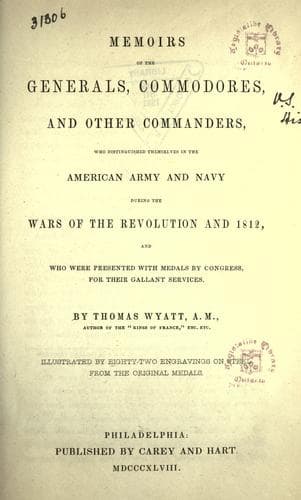
Memoirs of the Generals, Commodores and other Commanders, who distinguished themselves in the American army and navy during the wars of the Revolution and 1812, and who were presented with medals by Congress for their gallant servicesWyatt, Thomas
History
Memoirs of the Generals, Commodores and other Commanders, who distinguished themselves in the American army and navy during the wars of the Revolution and 1812, and who were presented with medals by Congress for their gallant services
Wyatt, Thomas
United States -- History -- Revolution, 1775-1783 -- Biography; United States -- History -- Revolution, 1775-1783 -- Medals; United States -- History -- War of 1812 -- Biography; United States -- History -- War of 1812 -- Medals
At a consultation among the generals it was determined that at
this post they should take their stand. After reconnoitering the
fortifications, and finding them so well prepared to resist an attack,
the British general re-embarked his forces and retired to Canada.
Immediately on the withdrawal of the British troops, General Gates
repaired to Washington’s army, leaving Colonel Wayne in entire charge
of Ticonderoga. This high compliment paid to Colonel Wayne, agreeable
to the troops and approved of by Congress, caused the gallant soldier
to be promoted to the rank of Brigadier-general. He remained at this
post six months, when, Washington having marched his main army into
Jersey, General Wayne solicited permission to join him, which he did
at Bound Brook, a few miles from Brunswick, in New Jersey. Soon after
the arrival of Wayne, General Howe, having received reinforcements
from England, at New York, took up his line of march across Jersey,
in order to intercept the American army before reaching Philadelphia.
Washington conceived the plan of General Howe to be to surprise the
city of Philadelphia and disperse the congressional assembly, who were
then sitting there; he accordingly dispatched Wayne and his troops to
meet and strike them, in order to resist their passage at Chad’s Ford.
This was done, and a sharp conflict ensued, which was gallantly kept up
until late in the evening, when it was thought prudent to retreat; the
loss sustained by the Americans was stated to be three hundred killed
and four hundred taken prisoners. The statement given by the British
general himself, was one hundred killed and four hundred wounded, but
which was afterwards ascertained to be nearly double that number. In
this battle the young patriot Lafayette first drew his sword in the
cause of America’s freedom, and although severely wounded in his leg at
the very onset of the battle, he continued to cheer and encourage his
soldiers, (with the blood flowing from his wound, having bound his sash
around it,) till the end of the conflict.
The British, taking a circuitous route, now marched with all haste
towards Philadelphia, and Washington wishing to give them the meeting
before reaching the city, retired to Chester, where both armies met at
some distance from the Warren tavern, on the Lancaster road. General
Wayne commenced the action with great spirit, but a violent storm came
on which rendered it impossible for the battle to continue, and each
army withdrew from the field.
Reviews
Reviews
No reviews yet
Be the first to share your thoughts on this work.
Join the Discussion
Join the discussion
Sign in to leave a comment or review.
Sign InorCreate an account