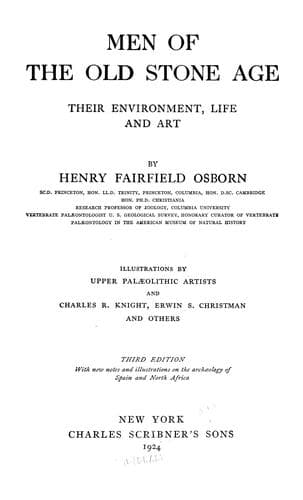
Men of the Old Stone Age: Their Environment, Life and ArtOsborn, Henry Fairfield
History
Men of the Old Stone Age: Their Environment, Life and Art
Osborn, Henry Fairfield
Art, Primitive; Prehistoric peoples; Stone age
There is some reason to believe that the Neanderthals were degenerating
physically and industrially during the very severe conditions of life of
the fourth glaciation, but the consequent inferiority and diminution in
numbers would not account for their total extinction, and we are inclined
to attribute this to the entrance into the whole Neanderthal country of
western Europe toward the close of Lower Palæolithic times of a new and
highly superior race. Archæologists find traces of a new culture and
industry in certain Mousterian stations preceding the disappearance of the
typical Mousterian industry. Such a mingling is found in the valley of the
Somme in northern France.
From this scanty evidence we may infer that the new race competed for a
time with the Neanderthals before they dispossessed them of their
principal stations and drove them out of the country or killed them in
battle. The Neanderthals, no doubt, fought with wooden weapons and with
the stone-headed dart and spear, but there is no evidence that they
possessed the bow and arrow. There is, on the contrary, some possibility
that the newly arriving Crô-Magnon race may have been familiar with the
bow and arrow, for a barbed arrow or spear head appears in drawings of a
later stage of Crô-Magnon history, the so-called Magdalenian. It is thus
possible, though very far from being demonstrated, that when the
Crô-Magnons entered western Europe, at the dawn of the Upper Palæolithic,
they were armed with weapons which, with their superior intelligence and
physique, would have given them a very great advantage in contests with
the Neanderthals.
(=1=) Commont, 1912.1, p. 294.
(=2=) Smith, W., 1894.1, chap. XV.
(=3=) Dietrich, 1910.1, pp. 329, 330.
(=4=) Penck, 1909.1.
(=5=) Leverett, 1910.1, pp. 306-314.
(=6=) Geikie, 1914.1.
(=7=) _Op. cit._, p. 272.
(=8=) _Op. cit._, pp. 265-266.
(=9=) Keith, 1911.1, p. 23, Fig. 5.
(=10=) Munro, 1912.1, pp. 46, 47.
(=11=) Lartet, 1861.1; 1875.1.
(=12=) De Vibraye, 1864.1.
(=13=) Massénat, 1868.1.
(=14=) Smith, W., 1894.1, chap. XIV.
(=15=) Geikie, 1914.1, p. 119.
(=16=) Smith, W., _op. cit._, pp. 196, 197.
(=17=) _Op. cit._, p. 224.
(=18=) Geikie, 1914.1, p. 118.
(=19=) Bächler, 1912.1.
(=20=) Schmidt, 1912.1, pp. 18-32, 165-171.
(=21=) _Op. cit._, Table opposite p. 270.
(=22=) Osborn, 1910.1, pp. 419, 420.
(=23=) Niezabitowski, 1911.1.
(=24=) Harlé, 1908.1, p. 302.
(=25=) Obermaier, 1912.1, p. 135.
(=26=) Keith, 1911.2.
(=27=) Boule, 1913.1, pp. 220, 221.
(=28=) _Op. cit._, p. 64.
(=29=) Fischer, 1913.1, pp. 336, 337.
(=30=) Schaaffhausen, 1875.1; 1858.1.
(=31=) Lyell, 1863.1, pp. 80-92.
(=32=) Schwalbe, 1897.1; 1901.1; 1901.2; 1904.1.
(=33=) King, 1864.1.
(=34=) Cope, 1893.1.
(=35=) Wilser, 1898.1.
(=36=) Fraipont, 1887.1.
(=37=) Schwalbe, 1914.2.
(=38=) Dupont, 1866.1.
(=39=) Maška, 1886.1.
(=40=) Rzehak, 1906.1.
(=41=) Fischer, 1913.1.
(=42=) Klaatsch, 1909.1.
(=43=) Bouyssonie, 1909.1.
Public-domain text, read in full here on John Shaqi.
Reviews
Reviews
No reviews yet
Be the first to share your thoughts on this work.
Elsewhere in the archive
Join the Discussion
Join the discussion
Sign in to leave a comment or review.
Sign InorCreate an account