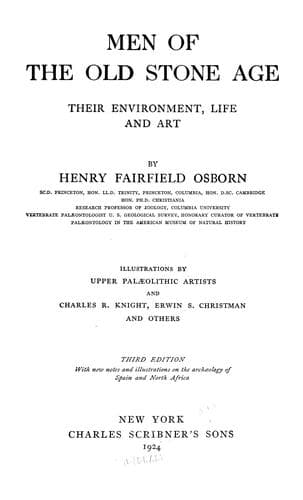
Men of the Old Stone Age: Their Environment, Life and ArtOsborn, Henry Fairfield
History
Men of the Old Stone Age: Their Environment, Life and Art
Osborn, Henry Fairfield
Art, Primitive; Prehistoric peoples; Stone age
The chief source of the change which swept over western Europe lay in the
brain power of the Crô-Magnons, as seen not only in the large size of the
brain as a whole but principally in the almost modern forehead and
forebrain. It was a race which had evolved in Asia and which was in no way
connected by any ancestral links with the Neanderthals; a race with a
brain capable of ideas, of reasoning, of imagination, and more highly
endowed with artistic sense and ability than any uncivilized race which
has ever been discovered. No trace of artistic instinct whatever has been
found among the Neanderthals; we have seen developing among them only a
sense of symmetry and proportion in the fashioning of their implements.
After prolonged study of the works of the Crô-Magnons one cannot avoid the
conclusions that their capacity was nearly if not quite as high as our
own; that they were capable of advanced education; that they had a
strongly developed æsthetic as well as a religious sense; that their
society was quite highly differentiated along the lines of talent for
work of different kinds. One derives this impression especially from the
conditions surrounding the development of their art, which are still
mysterious and an interpretation of which we shall attempt to give in the
following chapter.
CULTURAL, RACIAL, AND CLIMATIC DIVISIONS
The Upper Palæolithic covers the greater part of the 'Reindeer Epoch' as
it was conceived by Lartet and Christy, who began their systematic study
and exploration of the caves of Dordogne in 1863. They were soon joined by
Massénat and the Marquis de Vibraye, while Dupont took up the work in
Belgium and Piette made the artistic development, especially in the
Pyrenees, his chosen field.
Lartet was the first to perceive that the culture of the grotto of
Aurignac was quite distinct from that of the Lower Palæolithic in northern
France; he also recognized in the shelter of Laugerie Haute, in Dordogne,
that there was still another culture, which is now known as the Solutrean;
also that in the shelter of Laugerie Basse, in Dordogne, there was yet
another industry, that which we now know as Magdalenian. M. de Mortillet
was the first to recognize the superiority of the Solutrean industry in
stone, which in this period reached its height, and its succession by the
Magdalenian period, in which the industry in bone and horn reached a
climax; but he failed to recognize the very important preceding position
of the Aurignacian, and it was not until 1906 that the clear presentation
by Breuil of the entire distinctness of the Aurignacian industry led to
the adoption by the Archæological Congress at Geneva of three cultural
divisions of the Upper Palæolithic. In the meantime Piette had discovered
that in the Mas d'Azil there was a distinct cultural phase, the Azilian,
following the Magdalenian, and thus a fourfold division of the Upper
Palæolithic (Breuil,(7) Obermaier(8)) was established, as follows:
Public-domain text, read in full here on John Shaqi.
Reviews
Reviews
No reviews yet
Be the first to share your thoughts on this work.
Elsewhere in the archive
Join the Discussion
Join the discussion
Sign in to leave a comment or review.
Sign InorCreate an account