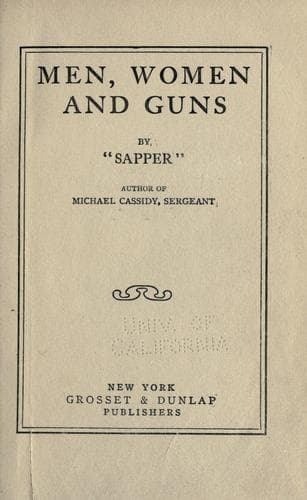
War stories, English; World War, 1914-1918 -- Fiction
Now it is, I believe, a principle of psychology that the brain or mind
of a man can be divided into two parts--the objective and the
subjective: the objective being that part of his thought-box which is
actuated by outside influences, by his senses, by his powers of
deduction; the subjective being that part which is not directly
controllable by what he sees and hears, the part which the religious
might call his soul, the Buddhist "the Spark of God," others instinct.
And this portion of a man's nature remains acutely active, even while
the other part has struck work. In fact, the more numbed and comatose
the thinking brain, the more clearly and insistently does subjective
instinct hold sway over a man's body. Which all goes to show that
discipline, if it is to be of any use to a man at such a time, must be a
very different type of thing to what the ordinary, uninitiated, and
so-called free civilian believes it to be. It must be an ideal, a thing
where the motive counts, almost a religion. It must be an appeal to the
soul of man, not merely an order to his body. That the order to his
body, the self-control of his daily actions, the general change in his
mode of life will infallibly follow on the heels of the appeal to his
soul--if that appeal be successful--is obvious. But the appeal must come
first: it must be the driving power; it must be the cause and not the
effect. Otherwise, when the brain is gone--numbed by causes outside its
control; when the reasoning intellect of man is out of action--stunned
for the time; when only his soul remains to pull the quivering, helpless
body through,--then, unless that soul has the ideal of discipline in it,
it _will_ fail. And failure _may_ mean death and disaster; it _will_
mean shame and disgrace, when sanity returns....
To the man seated at his desk in the company office these ideas were not
new. He had been one of the original Expeditionary Force; but a sniper
had sniped altogether too successfully out by Zillebecke in the early
stages of the first battle of Ypres, and when that occurs a rest cure
becomes necessary. At that time he was the senior subaltern of one of
the finest regiments of "a contemptible little army"; now he was a major
commanding a company in the tenth battalion of that same regiment. And
in front of him on the desk, a yellow form pinned to a white slip of
flimsy paper, announced that No. 8469, Private Meyrick, J., was for
office. The charge was "Late falling in on the 8 a.m. parade," and the
evidence against him was being given by C.-S.-M. Hayton, also an old
soldier from that original battalion at Ypres. It was Major Seymour
himself who had seen the late appearance of the above-mentioned Private
Meyrick, and who had ordered the yellow form to be prepared. And now
with it in front of him, he stared musingly at the office fire....
Public-domain text, read in full here on John Shaqi.
Reviews
Reviews
No reviews yet
Be the first to share your thoughts on this work.
Join the Discussion
Join the discussion
Sign in to leave a comment or review.
Sign InorCreate an account