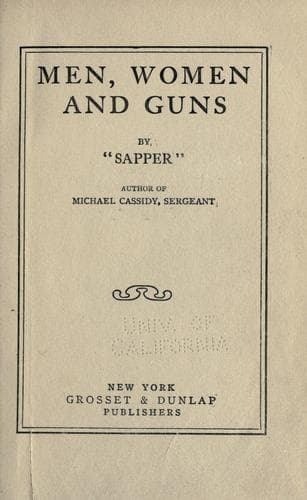
War stories, English; World War, 1914-1918 -- Fiction
There are a certain number of individuals who from earliest infancy have
been imbued with the idea that the chief pastime of officers in the
army, when they are not making love to another man's wife, is the
preparation of harsh and tyrannical rules for the express purpose of
annoying their men, and the gloating infliction of drastic punishment on
those that break them. The absurdity of this idea has nothing to do with
it, it being a well-known fact that the more absurd an idea is, the more
utterly fanatical do its adherents become. To them the thought
that a man being late on parade should make him any the worse
fighter--especially as he had, in all probability, some good and
sufficient excuse--cannot be grasped. To them the idea that men may not
be a law unto themselves--though possibly agreed to reluctantly in the
abstract--cannot possibly be assimilated in the concrete.
"He has committed some trifling offence," they say; "now you will give
him some ridiculous punishment. That is the curse of militarism--a
chosen few rule by Fear." And if you tell them that any attempt to
inculcate discipline by fear alone must of necessity fail, and that far
from that being the method in the Army the reverse holds good, they
will not believe you. Yet--it is so....
"Shall I bring in the prisoner, sir?" The Sergeant-Major was standing by
the door.
"Yes, I'll see him now." The officer threw his cigarette into the fire
and put on his hat.
"Take off your 'at. Come along there, my lad--move. You'd go to sleep at
your mother's funeral--you would." Seymour smiled at the conversation
outside the door; he had soldiered many years with that Sergeant-Major.
"Now, step up briskly. Quick march. 'Alt. Left turn." He closed the door
and ranged himself alongside the prisoner facing the table.
"No. 8469, Private Meyrick--you are charged with being late on the 8
a.m. parade this morning. Sergeant-Major, what do you know about it?"
"Sir, on the 8 a.m. parade this morning, Private Meyrick came running on
'alf a minute after the bugle sounded. 'Is puttees were not put on
tidily. I'd like to say, sir, that it's not the first time this man has
been late falling in. 'E seems to me to be always a dreaming,
somehow--not properly awake like. I warned 'im for office."
The officer's eyes rested on the hatless soldier facing him. "Well,
Meyrick," he said quietly, "what have you got to say?"
"Nothing, sir. I'm sorry as 'ow I was late. I was reading, and I never
noticed the time."
"What were you reading?" The question seemed superfluous--almost
foolish; but something in the eyes of the man facing him, something in
his short, stumpy, uncouth figure interested him.
"I was a'reading Kipling, sir." The Sergeant-Major snorted as nearly as
such an august disciplinarian could snort in the presence of his
officer.
"'E ought, sir, to 'ave been 'elping the cook's mate--until 'e was due
on parade."
Public-domain text, read in full here on John Shaqi.
Reviews
Reviews
No reviews yet
Be the first to share your thoughts on this work.
Join the Discussion
Join the discussion
Sign in to leave a comment or review.
Sign InorCreate an account