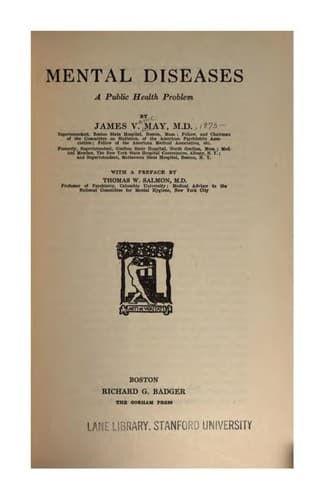
Mental diseases: a public health problemMay, James Vance
Science
Mental diseases: a public health problem
May, James Vance
Mental health services; Psychology, Pathological
The courts, the medical profession and the public have shown
indications of a decided dissatisfaction with existing methods of
determining criminal responsibility. This will certainly continue
as long as the sole test of competency is the power of the accused
to discriminate between a knowledge of right and wrong at the time
when the act is committed. The conditions which lead to crime have
been made the subject of scientific study by many. One of the early
investigators in this field was Morel, who saw in the criminal a
personification "of the various degenerations of the species." Much has
been said of "moral insanity," a condition referred to by Abercromby
as one "in which all the upright sentiments are eliminated while the
intelligence presents no disorders." Lombroso advanced the theory
that criminality is a form of atavism—a reversion of man to the
primitive and savage type represented by his early ancestors. This
theory was based on a careful study of the anatomical, physiological
and psychological characteristics of primitive man. His classification
included the occasional, the emotional, the born criminal, the moral
insane, and the masked epileptic. Marro offered an anatomical basis
for the degenerative theory in the form of nutritional defects in the
central nervous system. Ferri distinguished between criminal lunatics
and emotional criminals and held crime to be "a phenomenon of complex
origin and the result of biological, physical and social conditions."
"Habitual criminals," he says, "are the victims of a clear, evident
and common mental alienation which causes the criminal activity,"
while the occasional offenders are to be explained by "the impulse
of opportunities more than the innate tendency that determines the
crime." The emotional criminal, according to Ferri, is a sane and
moral individual overcome by momentary emotional paroxysms referred
to as a "psychologic storm." Garofalo, on the other hand, looked upon
crime as "an offense against the fundamental altruistic sentiments
of pity and probity." From his point of view a criminal act was an
indication of the loss of a proper sense of appreciation of the
life or property of another—a moral anomaly. The Italian school of
criminology was responsible also for the theory that criminal acts are
only the expression of epileptic symptoms. Sociological workers have
attributed crime to influences which overcome the natural resistance
of the individual, a variation from which is merely an inability of
the person to conform to the laws of environment. Max Nordau sees
in human failings only an abnormality which he describes as "human
parasitism." Others look upon crime as the natural product of a modern
social and economic system. Colajanni ascribes alcoholism, vagrancy
and prostitution to poverty, but crime, he says, is "due to necessity
and to the degree and kind of education received." In the light of our
present knowledge the conclusion would appear to be warranted that
Public-domain text, read in full here on John Shaqi.
Reviews
Reviews
No reviews yet
Be the first to share your thoughts on this work.
Elsewhere in the archive
Join the Discussion
Join the discussion
Sign in to leave a comment or review.
Sign InorCreate an account