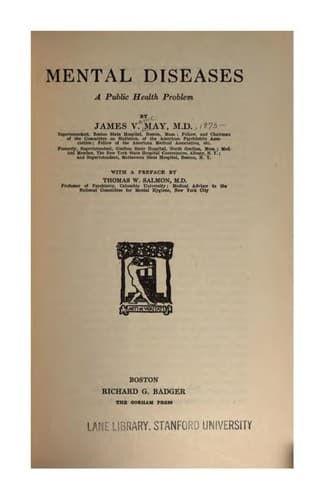
Mental diseases: a public health problemMay, James Vance
Science
Mental diseases: a public health problem
May, James Vance
Mental health services; Psychology, Pathological
The first authoritative information relative to the institution care of
mental diseases was obtained from the federal census reports of 1880.
In that year there were 40,942 patients in the public hospitals. In
1890 there were 74,028; in 1904, 150,151; in 1910, 187,791; in 1917,
232,873 and in 1918, 239,820. The rate per 100,000 of the population
increased from 81.6 in 1880 to 229.6 in 1918. From 1910 to 1918 the
general population increased 13.6 per cent and the hospital population
27.7 per cent. The rate per 100,000 of the population in institutions
in Massachusetts[5] on January 1, 1920, was 373.8, in New York 374.6,
in Connecticut 317.8, in Iowa 248.1, in Wisconsin 300.6, in California
297.2, in Pennsylvania 215.2, in Ohio 212.1, in Illinois 229.5 and in
Michigan 210.8. The admission rate per 100,000 of the population in
1917 was 151.6 in Massachusetts, 109.2 in Illinois, 124.8 in Montana,
97.3 in New York, 80.9 in Connecticut and 85.7 in California.
The cost of maintenance in the state hospitals increased to
$43,926,888.88 in 1917 with an average per capita cost of $207.28.
The number of cases cared for in some of the more populous states is
of interest. On January 1, 1920, the institution population of New
York was 38,903, Pennsylvania 18,764, Ohio 12,217, Illinois 14,884,
Massachusetts 14,399 and California 10,184.
Based on the estimated population of Massachusetts on July 1, 1920
(3,869,098), the 1,475 deaths in institutions for mental diseases
would represent a death rate of 38.12 per 100,000 of the population.
The death rate for other diseases for that year was: diphtheria 15.4,
measles 9.0, pulmonary tuberculosis 96.7, typhoid fever 2.5, whooping
cough 14.0, scarlet fever 5.5, syphilis 5.8, lobar pneumonia 71.9
and influenza 43.9. The importance to be attached, however, to such
comparisons is very uncertain at best. From the standpoint of social
and economic importance to the community there is another factor under
consideration which should not be overlooked. The duration of other
diseases, as a general rule, is comparatively short. A study of over
ten thousand deaths in New York state hospitals for mental diseases
shows the average hospital residence of these cases to have been over
six years. At the rate of admission to public institutions for 1917
(62,898) and the average per capita cost for that year ($207.28) the
care of persons admitted annually, during their years of hospital life,
would mean an expenditure of over seventy-eight millions of dollars.
Public-domain text, read in full here on John Shaqi.
Reviews
Reviews
No reviews yet
Be the first to share your thoughts on this work.
Join the Discussion
Join the discussion
Sign in to leave a comment or review.
Sign InorCreate an account