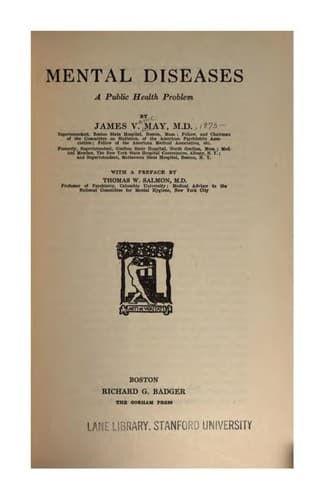
Mental diseases: a public health problemMay, James Vance
Science
Mental diseases: a public health problem
May, James Vance
Mental health services; Psychology, Pathological
If we figured the earning capacity of the 62,000 persons admitted to
institutions for mental diseases in the United States as averaging only
one thousand dollars per year, it would represent an economic loss to
the country of sixty-two millions of dollars annually. Estimated in
the same way, the total population of the hospitals would represent
the staggering sum of nearly two hundred and forty million dollars.
This, of course, does not take into consideration at all the cost of
maintenance or the property investment represented by hospitals.
To avoid any possibility of confusion, no reference has been made
heretofore to statistical studies of mental deficiency or epilepsy.
From a public health point of view, however, and as social and
economic problems, they are questions which cannot be disregarded
in a consideration of mental diseases. As a matter of fact, they
are very closely correlated in many ways. A survey made by the
National Committee for Mental Hygiene shows that on January 1, 1920,
there were in this country thirty-two state institutions for mental
defectives, eleven admitting both feebleminded and epileptics and
twenty exclusively for the latter class.[6] In addition to this, one
city institution was reported. Of the private hospitals twenty-seven
care for the feebleminded only, and six for epileptics, while
nineteen admit either of these classes. The total number of mental
defectives in institutions on January 1, 1920, was 40,519. At that
time 34,836 were in state, 2,732 in other public institutions and
2,951 in private hospitals. In the following states they are cared
for in hospitals for mental diseases, no other provisions having
been made for their treatment:—Alabama, Arizona, Arkansas, Florida,
Louisiana, Mississippi, Nevada, South Carolina, Tennessee, Utah and
West Virgina. The states reporting the largest number are New York
5,762, Pennsylvania 4,281, Massachusetts 3,192, Illinois 3,147, Ohio
2,435, Michigan 1,849, Iowa 1,704, New Jersey 1,762, Wisconsin 1,624,
Minnesota 1,502, Indiana 1,264 and Missouri 1,047. At the same time
there were 14,937 epileptics under treatment, 13,223 in state, 859 in
other public institutions and 855 in private hospitals. Colorado,
Delaware, Georgia, Nebraska, New Mexico and Washington take care of
the epileptics in their hospitals for mental diseases. The intimate
relation between mental diseases and epilepsy is shown by the fact
that as nearly as can be determined at this time approximately thirty
per cent of all of the epileptics in our state institutions have been
committed as insane. This, however, nowhere nearly includes all of the
cases which actually show mental disorders of one kind or another. The
states showing the largest numbers of epileptics are New York with
1,683, Ohio 1,680 and Massachusetts 1,227. No other states report
over one thousand, although Michigan and Pennsylvania have over eight
hundred and Illinois and Missouri over seven hundred.
Public-domain text, read in full here on John Shaqi.
Reviews
Reviews
No reviews yet
Be the first to share your thoughts on this work.
Join the Discussion
Join the discussion
Sign in to leave a comment or review.
Sign InorCreate an account